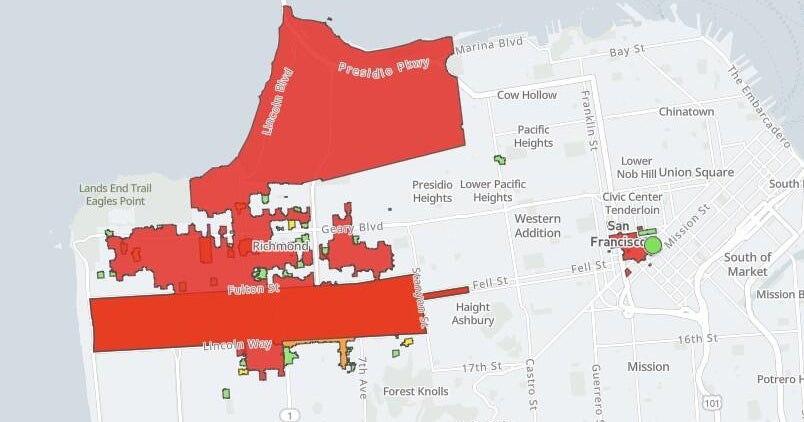
A PG&E substation fire caused significant damage and a widespread outage in San Francisco; PG&E said it restored power to about 110,000 customers but roughly 21,000 remained without electricity Sunday morning in neighborhoods including the Presidio, Richmond District, Golden Gate Park and parts of Downtown, with repairs described as complex and no estimated time for full restoration. Waymo suspended its robotaxi services during the outage, disrupting urban mobility; the incident poses localized operational and potential liability risks for PG&E and transport operators but is unlikely to have material near-term market-wide effects.
Market structure: A substation fire that knocked out ~130k customers (110k restored, ~21k still out) is a direct negative for incumbent utility PCG (Pacific Gas & Electric) via short-term outage costs and longer-term regulatory scrutiny, while equipment and battery/storage suppliers (Eaton ETN, ABB ABB, Enphase ENPH, Tesla TSLA) gain potential pricing power from accelerated replacement/hardening capex. Transportation tech (Alphabet/GOOGL/Waymo) faces immediate revenue/time lost but negligible long-term market-share shift unless repeated outages become systemic. Expect localized demand spike for crews/transformers and 1–3% temporary uplift in orders for grid-hardware over next 3–12 months.
Risk assessment: Tail risks include major regulatory fines or forced operational restrictions for PCG (high-impact, low-probability within 30–90 days) and contagion to California muni credit spreads (+10–50 bps) if investor confidence erodes. Immediate risk window: days–weeks for outages and service suspensions; short-term: 1–3 months for investigations; long-term: 6–24 months for capital programs and insurance repricing. Hidden dependencies: wildfire season correlation, insurance capacity, and supply-chain lead times (transformer lead times can be 6–12 months), which amplify second-order effects.
Trade implications: Tactical ideas — establish a 1–2% long position in ETN and 1% in ABB for 6–12 month hardware capex exposure; buy ENPH/TSLA 2–4% exposure (solar+storage) for 3–9 month distributed energy tailwind. Hedge/regulatory bet: initiate a 3–6 month PCG put spread (e.g., buy 30% OTM put, sell 20% OTM) sized 0.5–1% portfolio to cap downside. Pair trade: long ETN + short PCG (ratio 1:0.5) over 3–12 months. If CA muni 10y spreads widen >15 bps, reduce muni duration by 6–12 months.
Contrarian angles: Consensus focuses on PCG blame; markets may underprice the capex upside for equipment and distributed storage providers — if transformer lead times exceed 3 months, sales can jump 15–30% seasonally. Reaction could be overdone on PCG if restoration completes within 2–4 weeks and regulatory outcomes are incremental; conversely, rapid policy tightening (CPU C orders within 60 days) would punish PCG and benefit independents. Monitor CPUC filings, transformer order backlogs, and ENPH/TSLA inventory shipments as 30–90 day catalysts.
AI-powered research, real-time alerts, and portfolio analytics for institutional investors.
Request DemoOverall Sentiment
mildly negative
Sentiment Score
-0.30
