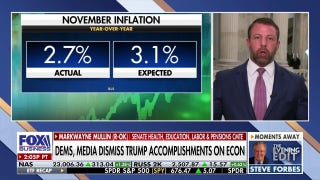
President Trump's address was framed as the opening salvo of an anticipated ‘‘Trump economic boom,’’ with commentator Larry Kudlow citing fresh CPI data showing a three-month headline increase of 2.1% and core CPI of 1.6%. Kudlow highlights a sharp fall in oil from around $100 to roughly $55/barrel and gasoline under $3 as deflationary drivers that should lower inflation and interest-rate pressure, support housing recovery and boost wage growth; he argues supply-side tax cuts, deregulation, expanded drilling and reciprocal trade policies will amplify business investment and factory-led job gains.
Market structure: falling oil (from ~$100 to ~$55) and 3‑month CPI ~2.1% (core 1.6%) shift winners toward consumer cyclical, transportation (airlines, autos), refiners and rate‑sensitive assets (REITs, long‑duration growth). Losers are US E&P and oil services (capex contraction), commodity exporters and any firms with energy‑linked input costs. Supply/demand imbalance in crude implies at least a multi‑quarter period of weak upstream cashflows but transient downstream relief (lower jet/gasoline costs boost margins elsewhere).
Risk assessment: key tail risks are a supply shock (Geopolitical/OPEC cut) spiking WTI >$90 within 30–90 days, a fiscal stimulus that reaccelerates inflation forcing Fed hikes (10y >4.0%), or trade‑policy retaliation that derails reshoring. Immediate (days): oil volatility and CPI prints; short (weeks/months): Fed/fiscal announcements; long (quarters/years): capex cycle and reshoring that can shift global supply chains. Hidden dependencies include energy capex feedbacks that reduce manufacturing and service jobs, and deficit‑driven upward pressure on long yields despite near‑term disinflation.
Trade implications: tactically favor rate‑sensitive and consumer plays while trimming upstream energy exposure. Cross‑asset: expect downward pressure on nominal yields and curve flattening if disinflation persists, supporting duration and REITs but hurting regional banks. Catalysts to watch (trade triggers): next 2 CPI prints, weekly WTI crude prints, 10y Treasury >/<3.5% levels, and any announced fiscal/tax packages within 90 days.
Contrarian angle: consensus underestimates the lag between announced reshoring and actual capex—benefits to industrials/transport may take 6–18 months while energy weakness is immediate. Energy names may be over‑sold vs refiners/airlines; history (2014 oil crash) shows multi‑year upstream underinvestment can reverse quickly on any supply shock. Unintended consequence: cheaper fuel can widen the trade deficit and raise long yields later, so size positions with defined stops.
AI-powered research, real-time alerts, and portfolio analytics for institutional investors.
Request DemoOverall Sentiment
strongly positive
Sentiment Score
0.65
