
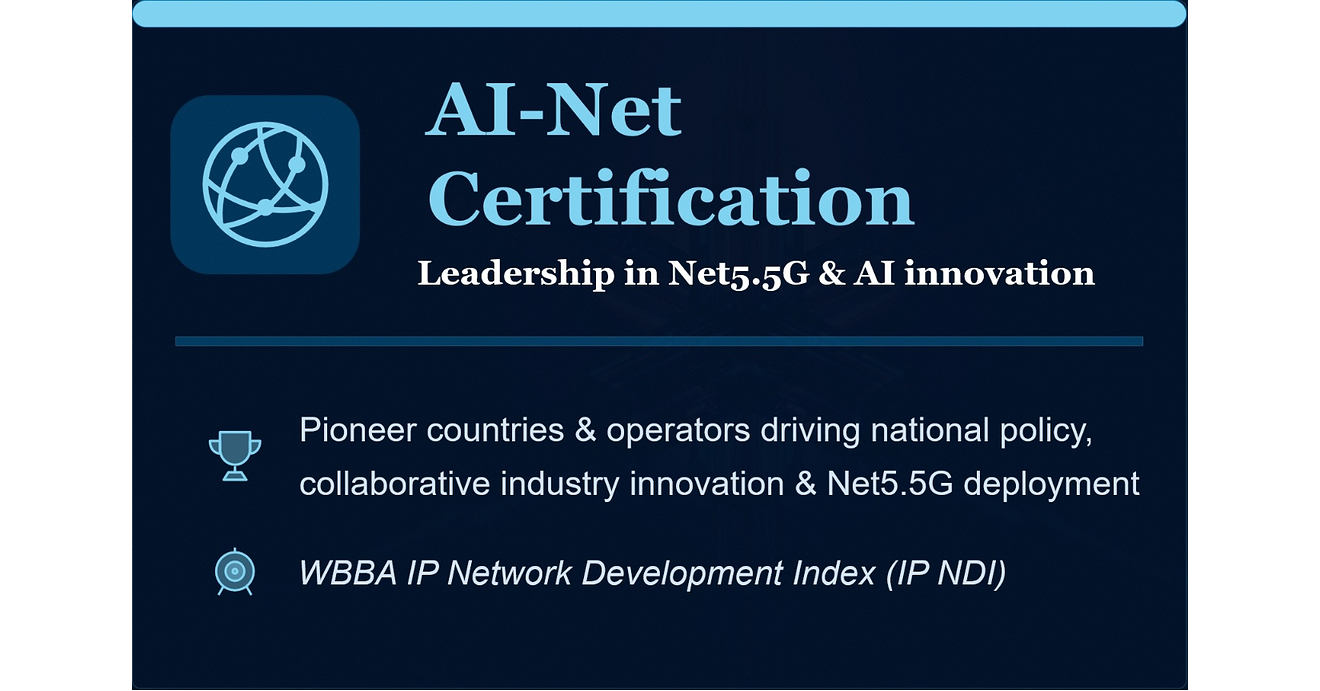
WBBA launched AI-Net, a globally authoritative data-communications certification aimed at accelerating Net5.5G deployment and shifting networks from connectivity to “all-intelligence.” The framework introduces three quantified pillars—national policy guidance, collaborative industry ecosystems, and Net5.5G penetration rate—using benchmarks such as IPv6/intelligent-network alignment and the operator IP Network Development Index (IPDI). The focus on deterministic performance (high throughput, zero packet loss, ultra-low latency) and AI-enabled self-healing/agentic operations is intended to reduce operator complexity and maintenance overhead, though it is primarily a standards/certification development with limited immediate market impact.
This is less a revenue event than a standards-shaping move. The real economic value is in procurement language: if AI-Net becomes a shorthand for budget approvals, it can bias spending toward vendors that bundle transport, optical, security, and automation rather than point-product winners. That favors integrated infrastructure names with strong carrier relationships and software-defined O&M stacks, while commoditized bandwidth providers face higher capex and only delayed monetization.
The second-order effect is margin pressure on operators before any efficiency gains show up. “AI for Network” sounds accretive, but in practice it usually front-loads software, upgrade, and integration costs; opex savings tend to arrive 2-4 quarters later, and only if adoption is deep enough to change fault rates and truck rolls. If this gets embedded into APAC public procurement or sovereign digital plans, the beneficiaries are likely ANET/CIEN/CSCO/ERIC/NOK-type infrastructure vendors and domestic China suppliers; if not, the signal remains mostly ceremonial.
Contrarian view: the market may be underestimating how much this is a policy instrument rather than a technology breakthrough. The article implies a capex cycle, but without named carrier budgets or national funding, the more likely outcome is selective pilot spending, not a broad upgrade wave. Falsifiers are simple: no follow-on guidance from operators, no mention in FY26 capex plans, or evidence that AI traffic growth is being absorbed by existing networks without material spend. In that case, the correct stance is to fade any initial enthusiasm in network equipment names.
AI-powered research, real-time alerts, and portfolio analytics for institutional investors.
Request TrialOverall Sentiment
mildly positive
Sentiment Score
0.12
Ticker Sentiment
