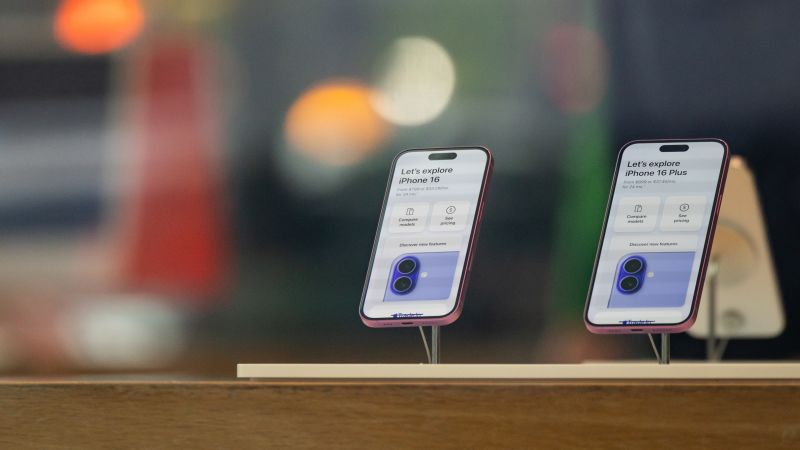
Former President Trump has threatened Apple with a 25% tariff on iPhones sold in the U.S. if the company does not shift production from countries like India and China to the United States. Analysts suggest that moving iPhone production to the U.S. would be challenging due to the specialized workforce and existing infrastructure in Asia, potentially leading to increased costs, design changes, and the need for significant automation to offset higher labor costs and skill gaps; however, Apple has not commented on the matter. While some believe that shifting some production to the U.S. is feasible in the long term, the company faces a difficult decision balancing economic realities with political pressure.
Former President Donald Trump's renewed pressure on Apple to manufacture US-sold iPhones domestically, threatening a 25% tariff if not, presents a significant challenge to the company's established global production model. Apple currently relies heavily on Asian manufacturing hubs, particularly China and, increasingly, India, for its iPhone production, with CEO Tim Cook recently stating he expected the majority of US-bound iPhones to be shipped from India. Experts cited in the article emphasize that relocating iPhone production to the US would be operationally complex and financially burdensome, potentially leading to substantial price hikes – one analyst estimated a tripling of device cost – or fundamental design changes. This is attributed to the highly specialized workforce, deeply integrated supply chains, and vast manufacturing infrastructure present in countries like China, exemplified by Foxconn's 900,000-strong peak workforce and specialized facilities. Replicating this ecosystem in the US faces hurdles such as a diminished manufacturing labor pool (8% of US workers in 2023 versus 26% in 1970), a skills gap for traditional assembly, and higher labor costs, although automation and multi-skilled workers, as demonstrated by Ultrahuman's US production shift, offer potential but complex mitigation. Cook himself has previously highlighted the unique combination of 'craftsman' skills, robotics, and computer science in China as crucial for Apple's quality standards. While Apple plans a $500 billion US investment for R&D, server facilities, and a smart manufacturing academy for SMBs, this does not directly address mass iPhone production infrastructure. Some analysts, like Patrick Moorhead, believe a partial shift to US production is feasible within five years but would necessitate significant automation and design alterations. Dan Ives estimates that even after shifting some production to India, around 40% of iPhone production remains in China. The overall moderately negative sentiment (-0.6) and specifically the highly negative sentiment for Apple (-0.8) underscore the market's concern over these potential disruptions and cost implications. Apple faces a difficult strategic choice: the economic impracticality of large-scale US iPhone production versus the political pressure to onshore manufacturing, a situation described by Forrester's Dipanjan Chatterjee as walking a 'tightrope'.
AI-powered research, real-time alerts, and portfolio analytics for institutional investors.
Request DemoOverall Sentiment
moderately negative
Sentiment Score
-0.60
Ticker Sentiment
