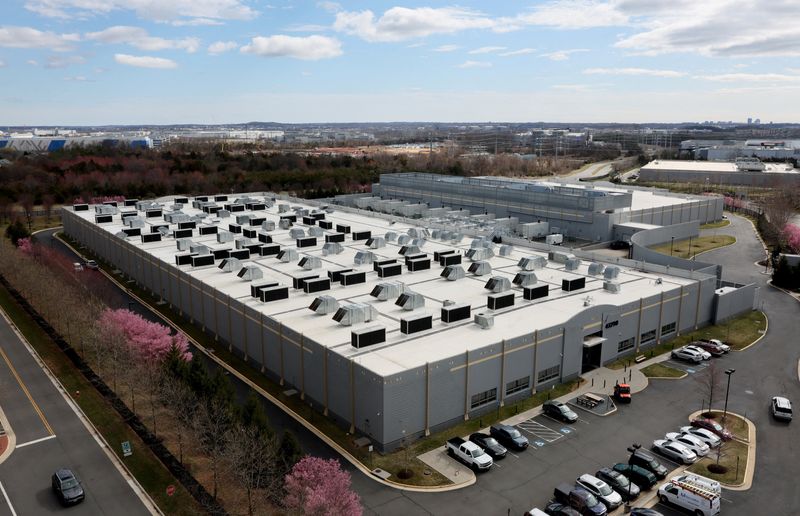
Bernstein says U.S. data center demand remains strongest in Major Metro markets, with Northern Virginia at about 8GW of supply, around 5GW under construction, and seven-year power queues. The firm sees Digital Realty and Equinix as relatively insulated from market noise, citing favorable dynamics in major metros like Atlanta, where pricing is about $175/KW/mo and vacancy is around 2%. Bernstein reiterated Outperform ratings on DLR and EQIX with price targets of $232 and $1,222, respectively.
The market is still underestimating how much of the AI-infrastructure value chain is becoming a geography game rather than just a chip or cloud game. In the hardest-to-build corridors, incumbents with existing power, permitting relationships, and customer trust should keep capturing disproportionate share, while smaller developers and land-bank speculators get squeezed by long lead times and rising carrying costs. That favors the large, established colocation owners not just on pricing, but on tenant stickiness and renewal economics as customers increasingly pay for certainty over theoretical supply.
The second-order winner is actually the capital stack: scarce deliverability in premium metros should keep cap rates anchored and make “announced pipeline” a more valuable asset than raw land or wholesale square footage. Builders outside the core metros can still win on speed, but that advantage narrows if hyperscalers become more latency selective and more willing to pay up for dense interconnection ecosystems. If power queues and community opposition persist for another 6-12 months, the gap between major-metro operators and speculative rural developers should widen materially.
The main risk is that consensus may be extrapolating straight-line demand into an environment where utility approvals, political pushback, or customer mix changes can slow absorption. If AI inference workloads shift more toward centralized cloud regions or if customers decide to optimize cost over latency, some of the premium attached to the tightest markets could compress. That said, this is not an immediate reversal story; the relevant watch window is months, not days, because site selection and power delivery are multi-quarter commitments.
The contrarian angle is that the “scarcity premium” may be underappreciated in public comps even though the operating model is increasingly analogous to regulated infrastructure. Investors still treat data center REITs like cyclical real estate, when the more important driver is the monetization of embedded optionality in power-constrained land and interconnect-rich campuses. If the market starts pricing these names on replacement cost plus strategic scarcity, upside could extend beyond near-term lease-up visibility.
AI-powered research, real-time alerts, and portfolio analytics for institutional investors.
Request DemoOverall Sentiment
mildly positive
Sentiment Score
0.25
Ticker Sentiment
