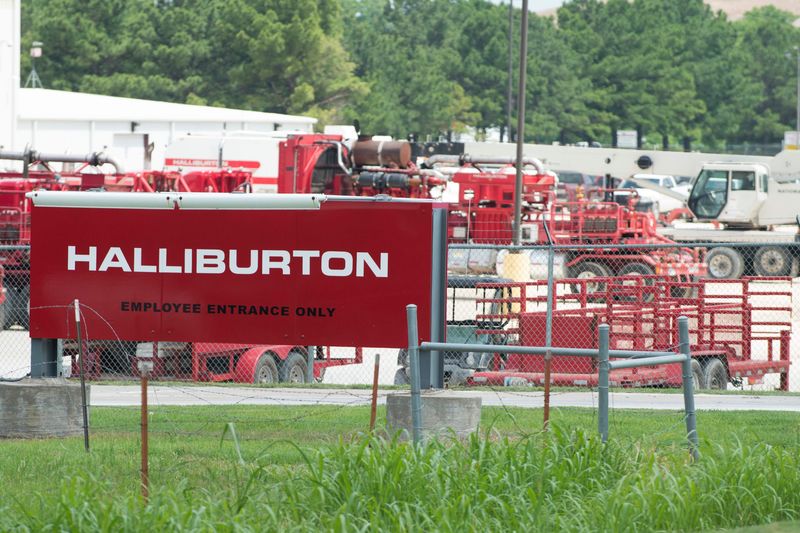
Halliburton beat Q1 expectations with adjusted EPS of $0.60 vs. $0.50 consensus and revenue of $5.4 billion vs. $5.31 billion expected, sending shares up 1.5% premarket. Operating margin was 13%, while adjusted operating income fell to $679 million from $787 million a year ago. Management said North America shows early signs of recovery, while international performance outpaced disruption from Middle East conflict.
HAL’s beat matters less as a one-quarter print and more as confirmation that the margin inflection in global oilfield services is arriving before the capex cycle is fully obvious in consensus. The first-order read is “North America recovery,” but the second-order implication is more important: international resilience through Middle East disruption suggests pricing power is still intact even where activity is noisy, which usually precedes broader OFS multiple expansion rather than just an earnings beat.
The market is likely underappreciating how much of HAL’s near-term upside can come from mix and utilization rather than just raw rig count growth. If North American stimulation and lift recover into the next 2-3 quarters, earnings leverage should be disproportionate because the incremental margin on incremental activity is far higher than the reported current margin level implies. That makes the stock more attractive on a 3-6 month view than the headline beat suggests, especially if investors rotate toward cash-generative cyclicals with improving revision momentum.
On the AMZN side, the announced funding scale signals a strategic escalation in the AI arms race, not just a vendor partnership. The second-order winners are the infrastructure enablers in the cloud/AI supply chain: incremental demand for training and inference capacity should support network, power, and semiconductor ecosystems, while raising the competitive bar for hyperscalers that are not as aggressively monetizing AI capacity. The risk is that consensus may extrapolate too much near-term monetization from an investment that is likely to depress near-term ROI optics before it expands platform lock-in over years.
Contrarianly, the move may be underdone in one place and overdone in another: HAL’s share reaction may be too modest if U.S. activity truly is at the start of a multi-quarter recovery, while AMZN’s rally could be too eager if investors assume immediate earnings accretion from strategic AI spend. The cleanest setup is to own the cyclical cash-flow acceleration in HAL while treating AMZN as a longer-duration strategic compounder whose main near-term catalyst is sentiment and optionality, not line-item earnings contribution.
AI-powered research, real-time alerts, and portfolio analytics for institutional investors.
Request TrialOverall Sentiment
mildly positive
Sentiment Score
0.35
Ticker Sentiment
