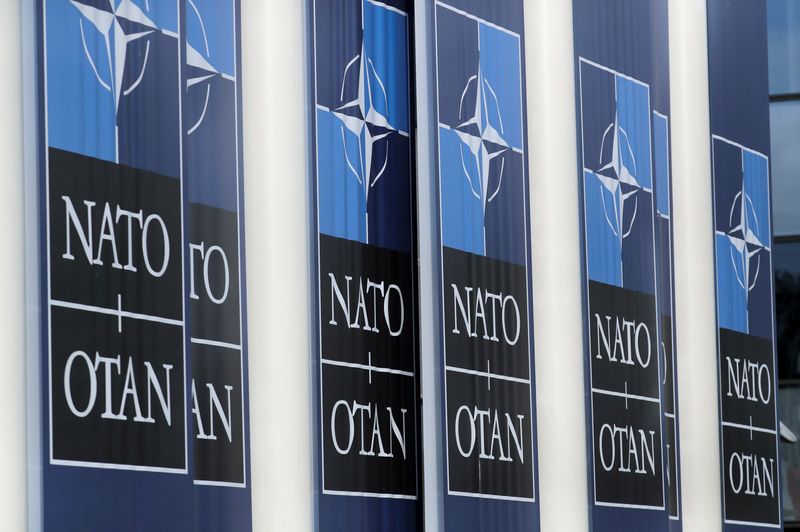
European officials are reportedly drafting a contingency plan for NATO if the U.S. withdraws, including greater European control of NATO command-and-control roles and replacement of U.S. military assets. The article highlights rising concern over U.S. commitment under President Trump, alongside ongoing worries about the war in Ukraine and security around the Strait of Hormuz. The tone is cautious and risk-off, with geopolitical implications that could weigh on European defense and broader market sentiment.
The market implication is not a direct sector call yet; it is a regime shift in how Europe prices sovereign risk and industrial policy. If Washington’s security backstop becomes less reliable, Europe has to spend more on defense, command-and-control, logistics, cyber, space, and munitions — areas where the bottleneck is capacity, not demand. That favors suppliers with near-term production availability and NATO-compatible systems, while penalizing firms dependent on U.S.-centric procurement certainty or deferred budgets.
The second-order effect is that this is broader than pure defense primes. A credible European rearmament push should lift industrials tied to power generation, secure communications, sensors, semiconductors, and transport infrastructure, because the weak link in defense is often the supply chain beneath the headline platforms. Over 6-24 months, the most important beneficiaries may be mid-cap subcontractors and dual-use names with long backlogs and pricing power, not the largest primes that are already valued for a normalization that may now prove too conservative.
The key risk is that this remains mostly rhetoric until a concrete U.S. policy move forces budget revisions. In the next few days, this can trade as a headline hedge; over months, it becomes a capex cycle if Europe front-loads spending and loosens fiscal rules. The contrarian view is that consensus may overestimate how quickly Europe can execute: procurement fragmentation, labor constraints, and ammunition/propulsion bottlenecks could delay the earnings impact, creating a cleaner entry point on any initial rally fade in the next 1-2 weeks.
If the U.S. is perceived as less dependable, NATO-adjacent equities should gain relative to purely domestic European cyclicals, but the trade is not ‘buy all defense’ indiscriminately. The best risk/reward is in names with visible backlog conversion and exposure to European replenishment, where estimate revisions can outpace multiple expansion. Any reversal would likely require a clear presidential walk-back or a formal reaffirmation of U.S. NATO commitment, which would compress the geopolitical risk premium quickly.
AI-powered research, real-time alerts, and portfolio analytics for institutional investors.
Request TrialOverall Sentiment
mildly negative
Sentiment Score
-0.15
