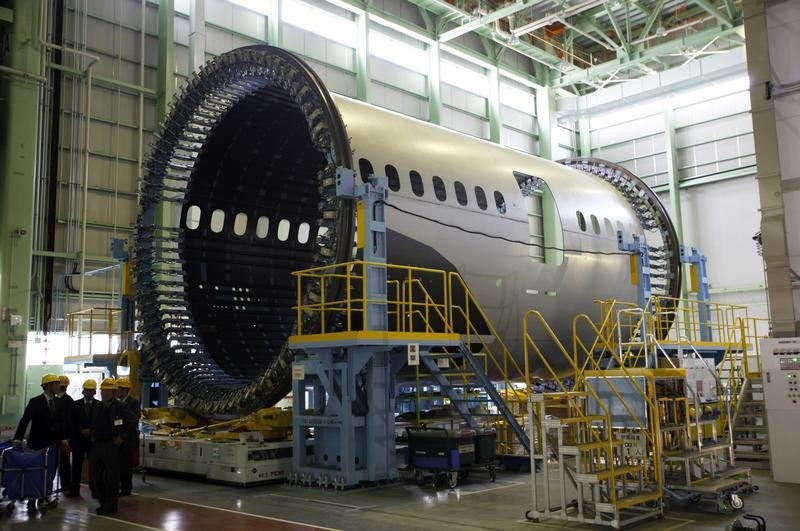
Baird reiterated an Outperform rating on Boeing with a $300 price target, implying about 30% upside from the current $231.28 share price. Boeing’s Q1 2026 results beat expectations, with EPS of -$0.20 versus -$0.66 consensus and revenue of $22.2B versus $21.99B expected, while production schedules and over $10B in projected free cash flow remain on track. The update is supportive for the stock, but the presence of valuation concerns tempers the overall tone.
The market is starting to price Boeing less like a turnaround story and more like a self-funding industrial with option value on normalization. The key second-order effect is not the headline beat, but that sustained rate stability at 737/787 plus the services margin reset should improve conversion of incremental revenue into cash faster than consensus models likely assume, which matters because Boeing’s valuation is still anchored to skepticism about free cash flow durability. If that cash flow starts to look repeatable, the multiple can rerate before the earnings fully inflect.
The broader winner set extends beyond BA. A cleaner Boeing production cadence should tighten demand visibility for tier-1 and tier-2 suppliers, but the real beneficiaries may be bottlenecked aerospace names with pricing power in engines, interiors, and specialized structures; the supply chain tends to reprice ahead of actual delivery growth. Conversely, airlines do not benefit equally: higher OEM confidence can eventually mean firmer aircraft pricing and less room for fleet renewal discounts, so the near-term positive for BA is not automatically a positive for customer capex economics.
The main risk is timing mismatch. Much of the good news is now pushed into the second half of 2026 and beyond, so if any of the rate-break assumptions slip by even one quarter, the market could de-rate the stock quickly because the current setup relies on a clean execution runway. The real bear case is not another one-off quarter miss; it is that investors conclude Boeing is still in a “promise stack” phase where cash flow is visible only if every operational milestone lands on schedule.
Contrarian-wise, the consensus may be underestimating how much operating leverage exists once services margins stay elevated and incremental commercial output is absorbed without quality setbacks. But the market may also be overestimating how quickly that leverage flows through to equity value, because aerospace investors typically pay up only after they see multiple quarters of stable delivery, not one quarter of better prints. That makes this a timing trade more than a pure fundamental long, with the best setup likely before the next production update rather than after it.
AI-powered research, real-time alerts, and portfolio analytics for institutional investors.
Request TrialOverall Sentiment
mildly positive
Sentiment Score
0.45
Ticker Sentiment
