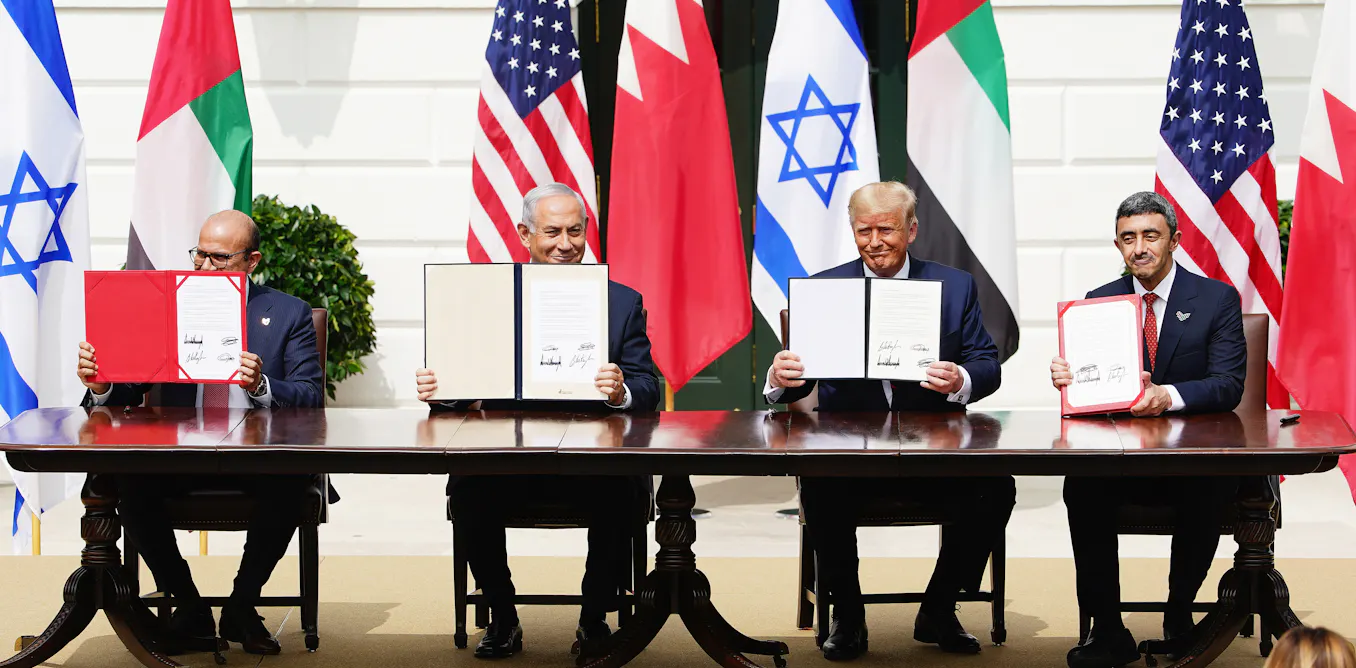
Trump is pushing Middle East partners to join the Abraham Accords as part of any Iran peace deal, but key states like Pakistan and likely Saudi Arabia are resisting without Palestinian statehood guarantees. The article highlights a region-wide strategic reset after the US-Iran war, with Gulf allies questioning the US security umbrella and energy-market disruptions feeding domestic pressure. Market implications are broad and geopolitically driven, but the piece is primarily about diplomatic positioning rather than an immediate economic data point.
The key market implication is not the diplomacy headline itself, but the growing gap between US signaling power and actual regional leverage. If Gulf states conclude that US security guarantees failed to prevent spillover, the marginal buyer of US defense, intelligence, and basing arrangements becomes less certain, which can pressure future Pentagon-linked capex and weaken the bid for political-risk hedges in the region. That also raises the probability of a more autonomous Gulf foreign policy, which is usually negative for Washington-aligned asset pricing because it reduces the premium on US “security umbrella” assets. A second-order effect is that any revived normalization push likely becomes a slower-burn catalyst rather than a binary event. The near-term winner is probably not Israel-linked assets, but volatility itself: unresolved regional realignment tends to support oil optionality, freight insurance, and CDS on the most exposed sovereigns while punishing high-beta EM proxies that rely on stable Gulf capital flows. If Saudi Arabia hardens around a Palestinian-state precondition, the market should read that as a multi-quarter obstacle to broad normalization, not a negotiating posture, which lowers the odds of a quick rerating in regional risk assets. The contrarian point is that the market may be underestimating how much of this is about domestic political theater rather than executable policy. That matters because if the push fails, it can actually accelerate the opposite trade: stronger local diversification, higher defense self-sufficiency, and more intra-Gulf capital recycling away from US systems. In that scenario, the medium-term beneficiaries are non-US defense suppliers, domestic industrialization plays in the Gulf, and energy producers with less geopolitical overhang; the losers are US security-adjacent primes and countries whose valuations still assume a stable US-mediated regional order.
AI-powered research, real-time alerts, and portfolio analytics for institutional investors.
Request DemoOverall Sentiment
mildly negative
Sentiment Score
-0.15
