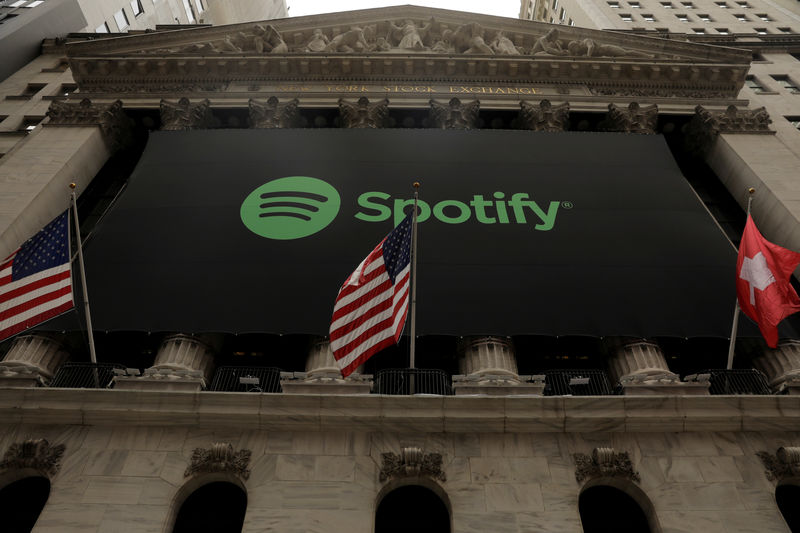
KeyBanc cut Spotify’s price target to $680 from $745 while keeping an Overweight rating, citing lower 2026 and 2027 operating profit forecasts that were reduced by about 6% each year. The stock trades at $434.20, down nearly 17% over the past week and well below the new target and its $785 52-week high. Recent analyst actions remain mixed, with several firms still positive but trimming targets amid heavier investment and expense concerns.
The market is starting to price Spotify less like a mature cash compounding story and more like a long-duration platform reset: if management is deliberately suppressing near-term margin to fund product and AI/compute investment, the key question is whether those dollars translate into higher engagement and pricing power before patience runs out. That creates a classic second-order setup where the stock can remain weak even on decent reported revenue, because the denominator of “what earnings should have been” keeps rising faster than the business is willing to monetize it.
The near-term winner is likely the ecosystem around ad tech, creator tools, and podcast distribution rather than direct audio competitors. If Spotify sustains investment intensity while guidance stays soft, ad-supported listening and bundling partners can capture incremental usage without bearing the same cost burden; conversely, pure-play streaming peers with less scale could be forced to either match spend or accept slower share gains. The bigger hidden risk is that investor skepticism on profitability turns into multiple compression across the whole subscription-media group, especially for names where growth already depends on future monetization rather than current cash flow.
Catalyst timing matters: the next several weeks are mostly about narrative repair, not fundamentals. The inflection point is the investor day / product cadence window, where any evidence of better retention, higher ARPU, or measurable payback on new features could re-rate the stock sharply higher; absent that, the market may keep selling rallies into each incremental spend update. In other words, the setup is asymmetrically sensitive to proof of ROI rather than headline user growth.
Consensus may be underestimating how much downside is already embedded after the recent drawdown, but also overestimating the speed of any recovery. If the market decides the investment cycle is real, the stock can rerate quickly; if not, the path to the new target is likely a grind, not a snapback. The contrarian read is that the current weakness can be bought only if one believes the company will show a tangible product-driven monetization step within one or two quarters, not just another round of strategic commentary.
AI-powered research, real-time alerts, and portfolio analytics for institutional investors.
Request DemoOverall Sentiment
mildly negative
Sentiment Score
-0.15
Ticker Sentiment
