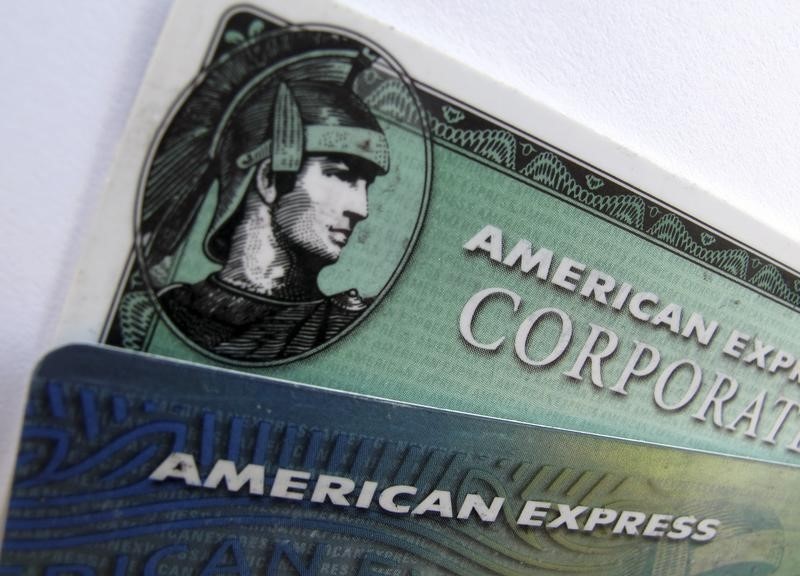
BTIG reiterated a Sell on American Express with a $285 price target while the stock trades at $316.34, down 14% YTD. Delta remains a critical partner (13% of billed business volume, 21% of loan balances) and AmEx paid Delta $2.2B (+10% YoY); card spend via the partnership rose 12% and BTIG estimates 46.9% of rewards expense is driven by Delta. Positive catalysts include five analyst upward EPS revisions, a multi-year NFL payments partnership beginning 2026, and the launch of the Graphite Business Cash Unlimited Card (2% unlimited cash back; 5% on flights/prepaid hotels; $295 annual fee).
American Express’s recent product and partnership push increases optionality in customer acquisition but raises a predictable margin timing mismatch: marketing-driven incremental billed volume flows through the P&L immediately as rewards/remuneration while the lifetime economics materialize over multiple years via interest and interchange. That creates a convexity where an acceleration in new-card signups can boost near-term revenues yet compress reported margins for 2–6 quarters before payback; model this as a 200–500bp incremental rewards headwind on new-book yield that only reverses as loan yields and retention ramp.
Competitively, scale in premium travel/enterprise channels favors networks with sticky corporate relationships and data-driven travel propositions; smaller issuers and closed-loop private-label programs will struggle to replicate retention economics, but large fintechs with lower-cost funding can undercut interchange-sensitive growth via aggressive cash-back promos. Downstream winners include travel-aggregator platforms and T&E software that monetize corporate travel data, while issuers carrying elevated reward liabilities are exposed to funding-cost volatility and regulatory scrutiny on interchange/reward accounting.
Key risks and catalysts are macro and credit-driven: a softening in corporate travel budgets or a rise in card delinquencies would flip the marketing convexity into a multi-quarter earnings drag, while sustained premium-travel demand would accelerate payback and justify higher valuation multiples. Near-term monitoring items (weeks–months) are new-card activation rates and reward burn; medium-term (3–12 months) are charge-off/income accrual trends and funding spreads; long-term (12–36 months) are regulatory changes to interchange/reward tax treatment or structural shifts in corporate travel policies.
AI-powered research, real-time alerts, and portfolio analytics for institutional investors.
Request DemoOverall Sentiment
mixed
Sentiment Score
0.12
Ticker Sentiment
