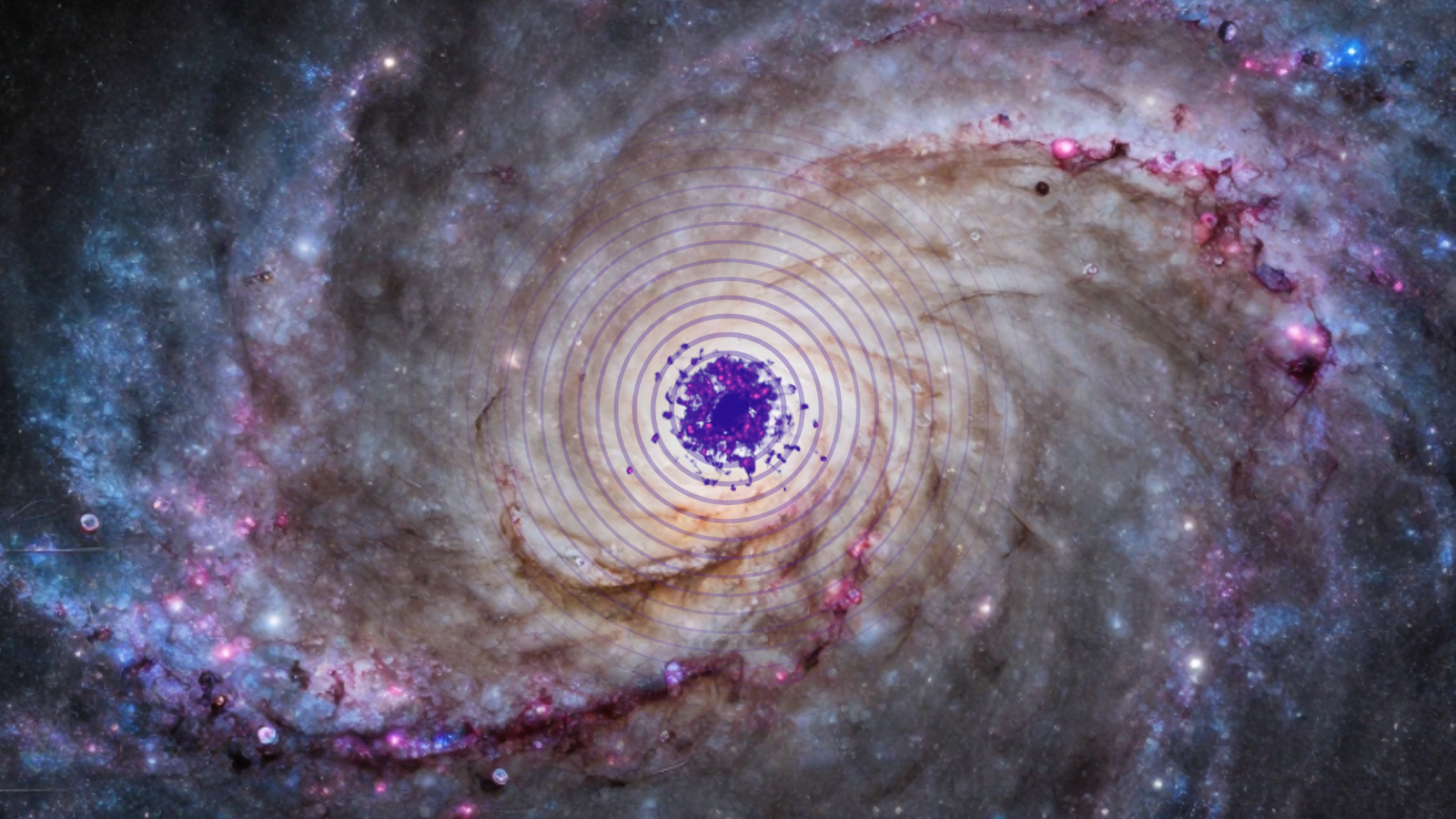
New machine-learning analysis of more than 1 million simulated gamma-ray observations does not rule out self-annihilating dark matter as the source of the Milky Way's Galactic Center Excess. The study suggests any pulsar explanation would require more than 35,000 extremely faint sources, making it nearly indistinguishable from the dark-matter signal. The work, published in Physical Review Letters, keeps the dark-matter hypothesis alive but does not confirm it.
This is not a tradable catalyst for listed equities today, but it is a meaningful signal for the scientific narrative around dark matter. The second-order implication is that the “pulsars vs. annihilating dark matter” debate is shifting from a binary detection problem to an inference problem where faint-source populations can masquerade as diffuse emission; that tends to increase the option value of platforms and toolchains used for indirect detection, but only over a multi-year horizon.
For public markets, the nearer-term beneficiaries are the enablers of high-performance inference rather than the astrophysics claim itself: GPU/accelerated computing, scientific data software, and potentially space-based or ground-based detection infrastructure. If machine-learning classification becomes the dominant workflow for high-noise cosmology datasets, that supports a secular demand tail for compute-heavy workflows even if this specific hypothesis is ultimately wrong. The loser is “single-solution” certainty: any company or fund positioning on a clean dark-matter breakthrough should expect repeated reversals as better simulations and survey data reprice the odds.
The contrarian view is that this keeps the story alive but does not improve the investability of the thesis. Markets usually overestimate the speed at which frontier science monetizes; the more likely path is years of ambiguity, with occasional headline spikes that fade as soon as independent teams fail to reproduce the inference. The real catalyst would be a convergent result from a next-gen gamma-ray survey plus an orthogonal non-astronomy detection channel; absent that, this remains a noise event for risk assets and a slow-burn positive for compute and scientific instrumentation spending.
AI-powered research, real-time alerts, and portfolio analytics for institutional investors.
Request DemoOverall Sentiment
neutral
Sentiment Score
0.05
