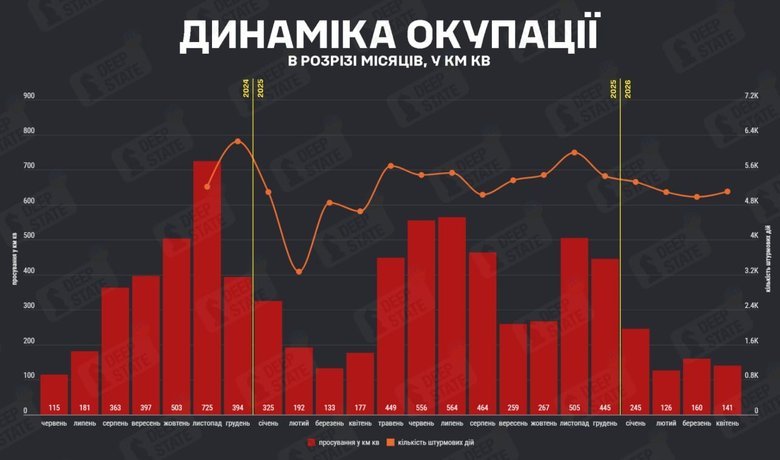
Russian forces occupied 141 square kilometers of Ukrainian territory in April 2026, down 11.9% from March, even as offensive operations rose 2.2%. Donetsk accounted for the largest share of advances at 53 square kilometers, followed by Sumy at 44 square kilometers, while the occupied area in Dnipropetrovsk fell from 105 to 98 square kilometers. The update is tactically important but is unlikely to have broad direct market impact.
The key read-through is not the headline level of territorial change, but the mismatch between lower land gains and higher operational tempo. That usually implies Russia is spending more shelling, drone coverage, and small-unit assaults to maintain pressure while the front becomes less efficient to move, which is a marginally better setup for Ukrainian defenders than a rapid-breakthrough scenario. In market terms, this is a slow-burn conflict regime: less likely to produce a sudden escalation shock, more likely to sustain elevated demand for munitions, air defense, ISR, and repair logistics over the next 6-18 months.
The second-order effect is on European defense procurement urgency. Even if the battlefield pace moderates, the persistence of multi-axis pressure keeps air defense and ammunition replenishment at the top of budget priorities, and the most direct beneficiaries remain the higher-quality European primes with backlog visibility and domestic production expansion. The more important signal is that attritional warfare is continuing to consume stockpiles faster than capacity can be rebuilt, which supports not just prime contractors but also the upstream supply chain in energetics, guided munitions, and electronic components.
A contrarian read is that incremental territorial changes may actually reduce near-term probability of a dramatic policy response, which can cap the reflexive bid in the most crowded defense names. If investors are already positioned for a worst-case escalation, this kind of data can be mildly bearish for short-dated momentum trades while still constructive for medium-term fundamentals. The tradeable distinction is between tactical headline hedges and structural beneficiaries of a prolonged rearmament cycle.
AI-powered research, real-time alerts, and portfolio analytics for institutional investors.
Request DemoOverall Sentiment
mildly negative
Sentiment Score
-0.15
