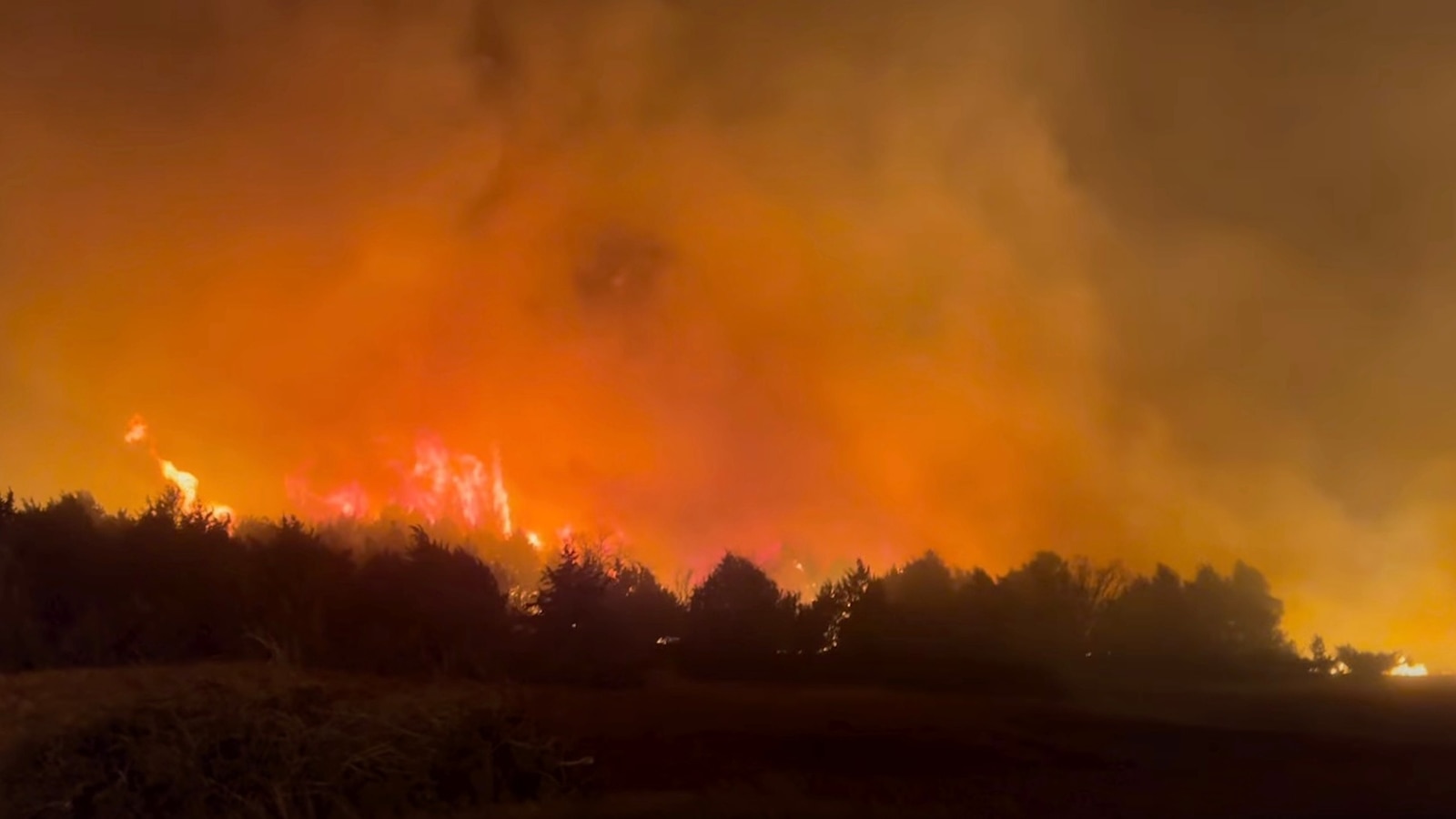
About 600,000 acres have burned across three major Nebraska wildfires, led by the Morrill Fire at >460,000 acres (the largest in state history); all fires were 0% contained and one person has died. Governor Pillen declared a state of emergency, deployed the Nebraska National Guard and requested municipal and interstate assistance; forecasted dry, windy conditions raise the risk of further spread, implying localized economic disruption to agriculture, infrastructure and potential insurance losses, but limited broader market impact.
The immediate market impact will be felt through regional commodity flows and logistics rather than headline firefighting activity. Expect local basis dislocations in corn/soymeal and feeder cattle markets as elevators and feedlots reroute supply; a realistic scenario is a 10–40c/bu basis widening for nearby elevators and a 2–6 week window of elevated freight/rail congestion that can amplify basis moves into cash market volatility.
Insurance and public‑finance channels are the most direct financial transmission mechanisms: insured losses concentrated in rural property and agricultural assets typically produce claims in the tens-to-low‑hundreds of millions range for events of this footprint, which can meaningfully press small‑jurisdiction muni spreads. Watch county-level budget reallocation, FEMA/state aid requests and potential intergovernmental friction in an election year—these are 1–9 month catalysts that can widen spreads 15–50bp for the most exposed issuers.
Defense/MRO and state procurement are non‑obvious upside pockets: accelerated National Guard and state helicopter/MRO activity tends to lift demand for spares, short‑term AOG services and later capital purchases; impact to public and private contractors typically manifests over 3–18 months as contracts, O&M hours and retrofit work flow through. The contrarian angle: near-term sentiment will push insurers down and local muni spreads up, but durable revenue opportunities for defense/MRO and freight/logistics providers are underappreciated and unfold on longer timelines, creating asymmetric trades across time horizons.
AI-powered research, real-time alerts, and portfolio analytics for institutional investors.
Request DemoOverall Sentiment
strongly negative
Sentiment Score
-0.75
