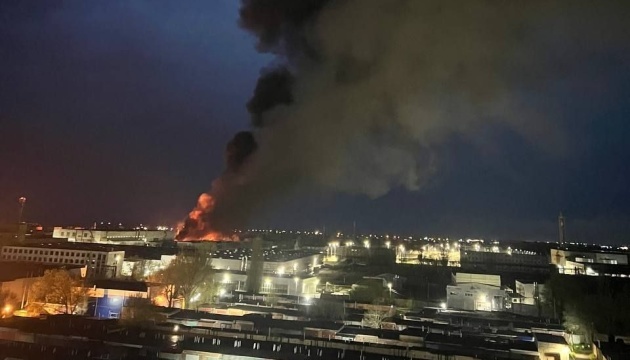
Ukraine's General Staff said it struck the Atlant Aero defense enterprise in Taganrog, setting off a fire and damaging production capacity for strike-reconnaissance UAVs and Orion components. It also reported hits on ammunition, logistics, and fuel storage sites in occupied areas, plus damage at the Tuapse oil refinery's AVT-12 unit, storage tanks, loading equipment, and terminal facilities. The attacks may further disrupt Russian drone production and fuel processing/logistics used to support military operations.
This is a supply-chain attrition event, not a one-off headline. Repeated hits on UAV assembly, ammo depots, fuel storage, and a refinery cluster the damage across the Russian military logistics stack: fewer drones, less fuel, slower resupply, and more maintenance bottlenecks. The second-order effect is that Russia may be forced to ration higher-value strike assets and shift to lower-quality substitutes, which can reduce sortie intensity before it shows up in broader battlefield headlines.
The market implication is most relevant for energy and defense sentiment rather than direct equity exposure. A disrupted Tuapse complex matters because it is not just a refinery but a storage-and-loading node; if throughput is impaired, domestic product balancing tightens in the Black Sea basin and raises the odds of incremental export curbs or rerouting costs. That tends to support regional middle distillate cracks and shipping complexity premia over a multi-week horizon, especially if repairs are slowed by follow-on strikes or insurance/port restrictions.
The key risk is that these effects are temporary unless the strike cadence is sustained. If repair cycles stay under a few weeks and Russia shifts logistics deeper inland, the price impact fades quickly; if strikes persist into a 1-3 month window, the cumulative hit becomes more meaningful because maintenance backlogs and spare-part shortages compound. The consensus may be underestimating the asymmetry: individual facilities are repairable, but the coordination burden across fuel, munitions, and drone production is much harder to restore than a single plant.
Contrarian view: the immediate market reaction could be overdone if traders extrapolate tactical damage into structural supply loss. For energy, the more durable signal is not crude supply destruction but product logistics disruption and military fuel prioritization, which is narrower and more transient than a broad oil shock. That argues for expressing the view through relative-value energy products and defense volatility rather than outright directional crude.
AI-powered research, real-time alerts, and portfolio analytics for institutional investors.
Request TrialOverall Sentiment
strongly negative
Sentiment Score
-0.55
