

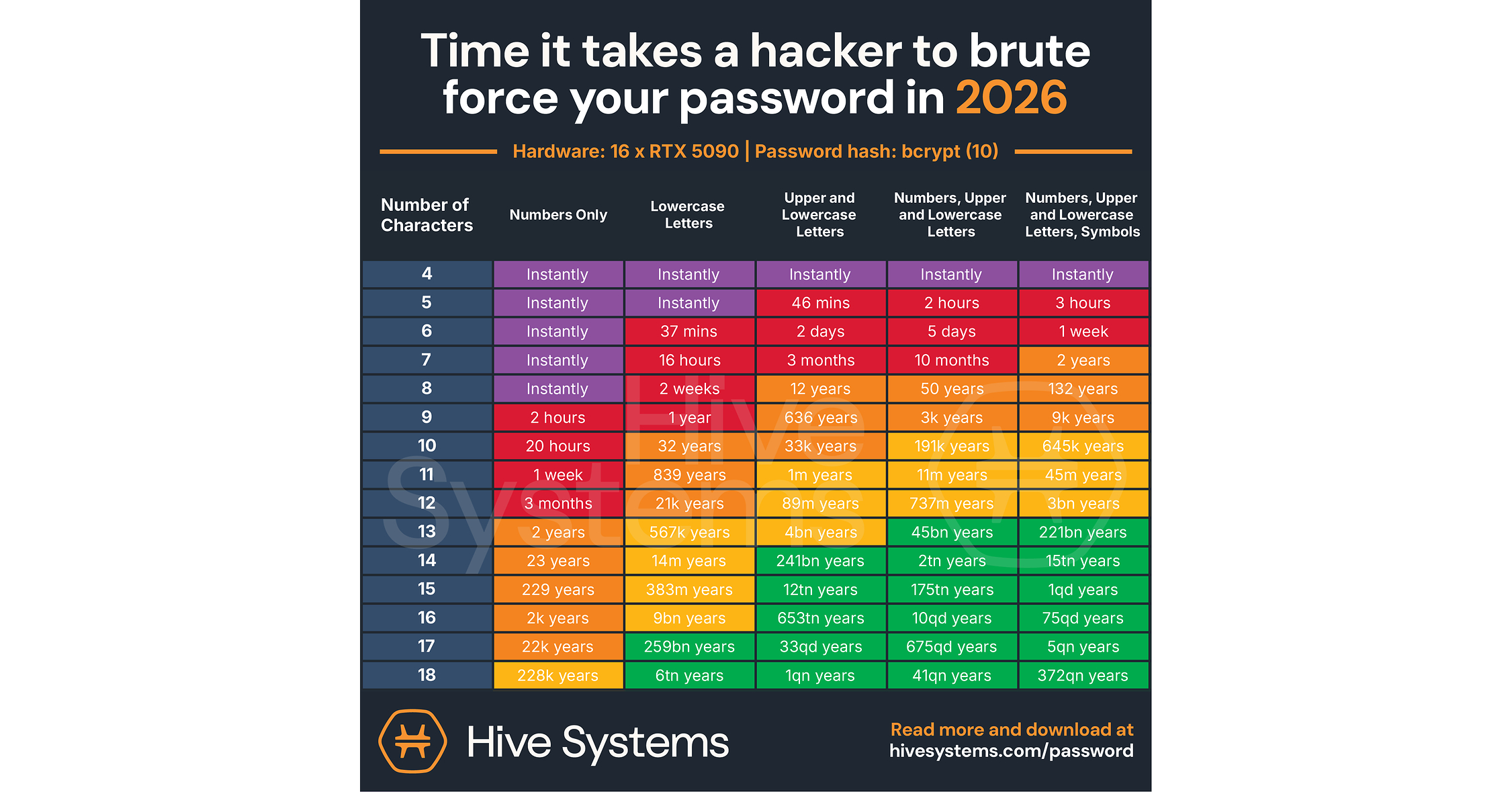
Hive Systems’ 2026 Password Table reports brute-force time for an 8-character randomly generated password falling from 225 years (2024) to 164 years (2025) to 132 years (2026), a ~20–25% annual decline using the same bcrypt hashing standard. The report argues the faster cracking is driven more by easier attacker infrastructure (multi-GPU setups and AI-assisted exploitation) than by “AI-grade” cracking hardware, while warning that quantum computing is the next shift via “harvest now, decrypt later” risks to encryption. Overall, it reinforces worsening password security timelines and the urgency to migrate to stronger/longer passwords and quantum-resistant controls.
The investable takeaway is not that passwords are suddenly brittle; it is that attacker economics are improving on the access path, which shifts spend away from pure password hygiene and toward identity, endpoint, and privileged-access controls. That is structurally favorable for names like CRWD, PANW, ZS, OKTA, and CYBR, because the budget line that gets protected is incident containment and credential compromise prevention, not faster hashing. For this to matter in earnings, enterprises need to translate fear into a higher renewal rate or incremental module attach; otherwise it stays a boardroom narrative.
The quantum angle is longer-dated but more consequential for procurement cycles. “Harvest now, decrypt later” can accelerate post-quantum migration work in government, finance, and healthcare, but the monetization is lumpy and mostly shows up as services and roadmap spend before it becomes a software revenue tailwind. That makes IBM and large integrators like ACN more plausible second-order beneficiaries than the speculative quantum-computing cohort, which still needs real commercial workloads, not just a security thesis, to justify valuations.
The contrarian view is that the market may be overpricing the wrong layer: quantum hardware proxies can pop on narrative while the real economic winners are boring security incumbents with broad installed bases. Conversely, this is probably not a near-term short signal for cyber software because breach-risk headlines usually support budget persistence rather than cuts. The thesis would be falsified if enterprise security budgets compress in the next earnings season or if post-quantum migrations fail to show up in 2026-2027 guidance.
AI-powered research, real-time alerts, and portfolio analytics for institutional investors.
Request TrialOverall Sentiment
mildly negative
Sentiment Score
-0.30
Ticker Sentiment
