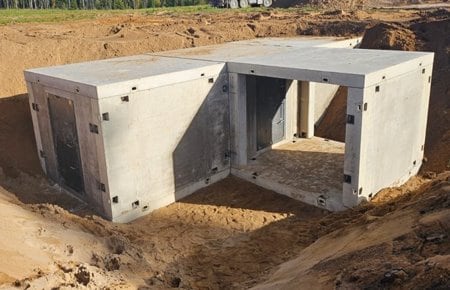
Estonia has begun installing the first concrete bunkers of a planned 600-unit Baltic Defense Line, with five bunkers deployed and a target of 28 in the ground by year-end as part of a €60 million program (about €30 million spent to date). Procurement complications forced a scale‑back to a 28-bunker pilot — revealing approximate locations to bidders to get realistic costs — and officials plan to tender the remaining 572 bunkers by year-end; the bunkers (~35 sq m) are designed to withstand 152mm artillery. Coordination with multiple stakeholders, peacetime legal constraints and Border Guard requirements have delayed some works (for example only 500m of a planned 3.4km test anti-tank trench is complete), but Estonia says the project strengthens NATO/EU eastern defenses and moves ahead ahead of its Baltic neighbors in physical implementation.
Market structure: The immediate spend is small (€60m total; ~€100k per bunker if 600 built) so direct winners are niche contractors, precast concrete suppliers and regional logistics firms rather than global primes. Materials (cement, rebar, precast) see a modest localized demand shock — expect a mid-single-digit uplift in Baltic volumes over 12–18 months, not a macro shift. Competitive dynamics favor firms able to survey sites quickly and offer modular/prefab solutions; bidders who demanded premiums due to site uncertainty will be penalized once site info is disclosed. Risk assessment: Tail risks include legal/environmental injunctions or Border Guard coordination failures that could increase costs >30% or halt works; geopolitical escalation could flip this from construction to military procurement with multi-year budgets (high impact, low probability). Near-term (days–weeks) key risk is tender structure; short-term (1–3 months) is award timing; long-term (quarters–years) is NATO/EU follow-on spending. Hidden dependencies: private land approvals, local labor availability, and transport bottlenecks for heavy precast units. Trade implications: Tactical trades should favor defense integrators with European land-systems exposure and modular construction specialists. Catalyst windows: tender awards by year-end and any EU/NATO co-funding announcements within 3 months. Cross-asset: expect minimal sovereign spread impact but slight EUR resilience on regional defense commitments; steel/cement futures could tick +1–3% near procurement spikes. Contrarian angle: The market underestimates signaling value — a €60m build can catalyze larger NATO logistics funding (potentially €0.5–2bn regional follow-on over 2 years), creating outsized backlog upside for select primes. Conversely, consensus may overpay defense names if investors price in full-scale rearmament; size positions small and use defined-loss options. Historical parallel: post-2014 Ukraine produced multi-year European prime order flow, not instant revenue, so patience and tender-level due diligence matter.
AI-powered research, real-time alerts, and portfolio analytics for institutional investors.
Request DemoOverall Sentiment
neutral
Sentiment Score
0.00
