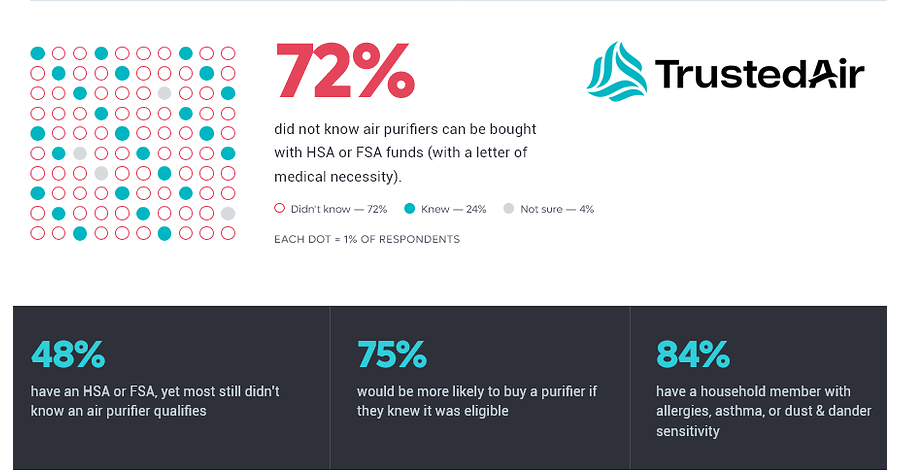
Survey data from TrustedAir shows 72% of Americans don’t know they can buy an air purifier using pre-tax HSA/FSA funds (with a letter of medical necessity), and 57% of current HSA/FSA holders still lack that awareness. Awareness is a key purchase driver: 75% say they’d be more likely to buy if they knew it qualified (rising to 89% among account holders). With 84% reporting allergies/asthma or dust/pet sensitivity in their households, TrustedAir positions its TruFlow purifier and Truemed checkout process as a way to reduce the utilization gap—though the article provides no financial metrics or quantified earnings impact.
No direct read-through to GAP; this is not a broad apparel-demand signal. The actual mechanism is conversion friction: if HSA/FSA checkout becomes better understood, it can lift purchase rates for health-adjacent home products without expanding the total wallet, which means the beneficiary is the seller with the easiest compliance workflow and strongest online conversion. That argues more for DTC-enabled appliance brands and marketplace sellers than for legacy big-box channels.
The likely winner is the brand that can capture high-intent seasonal demand and monetize it in one click, not the one with the best product specs. In the next 1-3 months, any uplift should show up first in search traffic, basket conversion, and accessories/filter attach, not in full-year revenue commentary. If the channel works, the second-order effect is share shift away from commoditized retailers that rely on promo and in-store discovery.
The contrarian risk is that this is mostly survey-backed marketing, not evidence of incremental demand; the HSA/FSA step can still fail at the documentation stage, and awareness campaigns often fade quickly. The thesis breaks if air-quality headlines normalize, if reimbursement workflows add too much friction, or if there is no measurable lift in sell-through or margin mix by the next two quarters. In that case, the market should treat this as a customer-acquisition tactic, not a category catalyst.
AI-powered research, real-time alerts, and portfolio analytics for institutional investors.
Overall Sentiment
neutral
Sentiment Score
0.05
Ticker Sentiment
