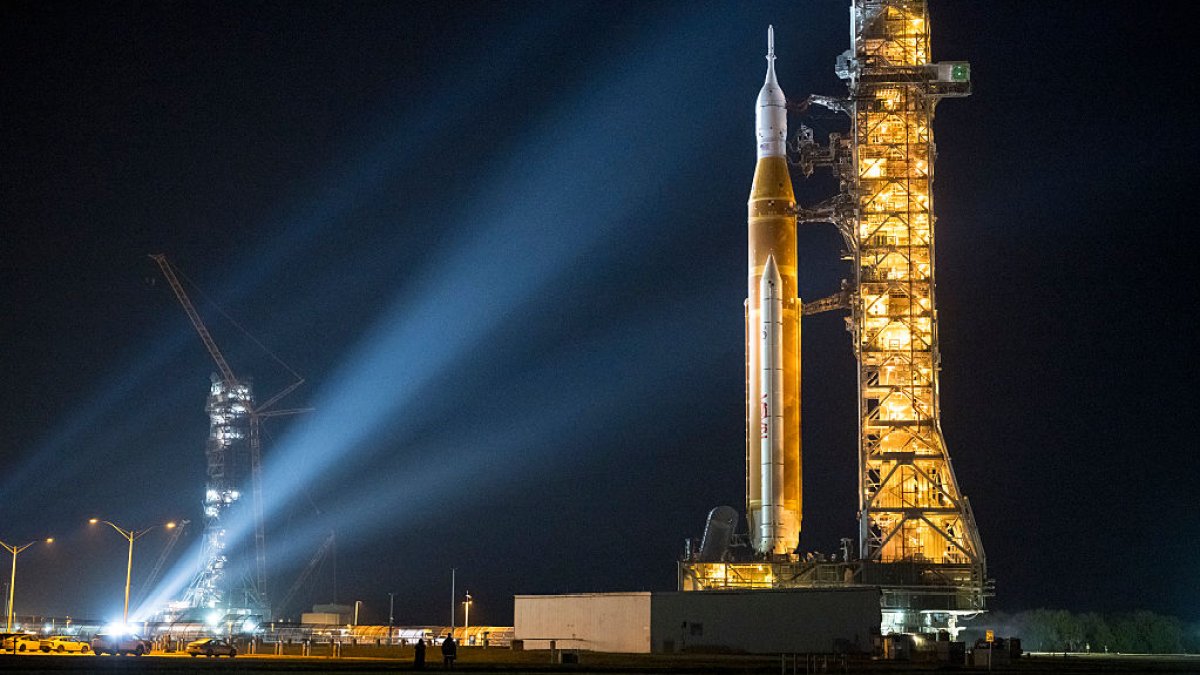
NASA rolled the 322-foot, 11-million-pound Artemis II rocket ~4 miles from the hangar to the launch pad starting 12:20 a.m. EDT; the move is expected to take about 12 hours ahead of a targeted April 1 launch. Artemis II will carry four astronauts on an approximately 10-day lunar flyby — the first crewed flight of the Artemis program — after engineers fixed a helium-flow blockage by replacing a seal, swapped batteries and completed tests. Mission managers completed a flight readiness review and certified the rocket and Orion spacecraft for the April launch attempt.
This flight functions as a program-level de‑risking event: a crewed success materially raises the probability that follow‑on NASA awards and multi‑year sustainment contracts flow to incumbents, concentrating billions of dollars of revenue across propulsion, avionics and mission‑integration suppliers over the next 12–36 months. Conversely, even a partial failure or extended anomaly sequence would shift program momentum toward faster, lower‑cost commercial alternatives and slow congressional appetite for large, legacy prime funding, creating a binary funding pathway for the next several budget cycles.
Operational fixes visible in recent troubleshooting (ground‑fed helium seals, cell replacement, battery swaps) tell us two things: contractors can iterate in situ, reducing single‑failure program cancels, but the program remains sensitive to small parts and ground‑support systems that have outsized schedule leverage. Expect revisions to spare‑parts inventories and LT supplier contracts; small, single‑source subcomponent suppliers have the largest percentage exposure to schedule moves and therefore the largest equity beta to mission outcome.
Near‑term catalysts are binary and short‑dated (launch window and safety reviews in days–weeks) and will drive intraday to weekly volatility in equities exposed to the program. Medium risk drivers over 6–18 months include congressional appropriation cycles and follow‑on procurement awards; a clean flight compresses political resistance and increases procurement velocity, while a failure increases program scrutiny and re‑prioritization toward commercially developed heavy launchers.
The consensus reaction will center on optics; the contrarian angle is that operational success could paradoxically mute the longer‑term upside for commercial heavy‑lift entrants by validating the incumbent procurement path. That creates a strategic window where primes and specialist suppliers rerate on near‑term visibility while the market underprices the political and competitive tilt that would revive commercial players if subsequent flights falter.
AI-powered research, real-time alerts, and portfolio analytics for institutional investors.
Request DemoOverall Sentiment
neutral
Sentiment Score
0.05
