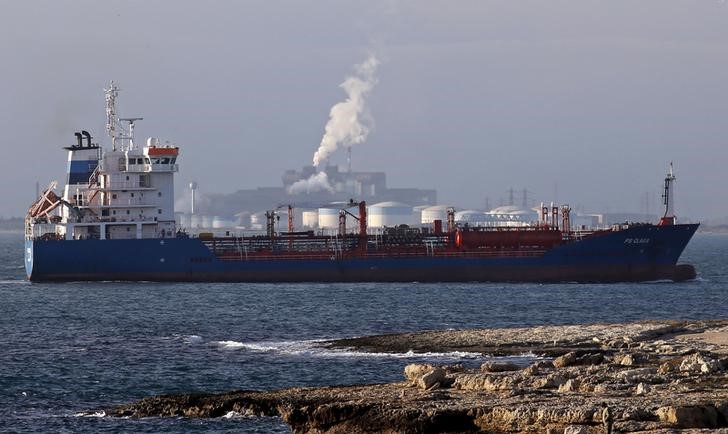
Iraq's crude exports through the Strait of Hormuz fell to just 10 million barrels in April from a historical monthly baseline of about 93 million barrels, underscoring a severe supply shock tied to the Iran war. The disruption helped lift global crude benchmarks, with Brent settling up 1.2% at $83.80 a barrel and WTI up 1.4% at $79.50, despite an EIA-reported 1.8 million barrel build in U.S. inventories. Baghdad is shifting volumes to overland routes and plans to raise Ceyhan exports from 200,000 barrels per day to 500,000 barrels per day, while also targeting 5 million barrels per day of production capacity.
The immediate winners are not just upstream barrels but every asset that sits on the bottleneck: non-Gulf seaborne crude grades, Atlantic Basin refiners with flexible diet options, and pipeline/rail logistics tied to land routes out of the region. The bigger second-order effect is that once a chokepoint is impaired, spot differentials can reprice much faster than headline benchmark futures; that tends to reward physical holders and punish end-users that rely on just-in-time inventory. The market is also likely underestimating the feedback loop into freight, marine insurance, and working capital: even if prices stabilize, these friction costs can keep delivered crude expensive for weeks.
The loser set is broader than energy consumers. Margins should compress first in chemicals, airlines, truckers, and industrials with limited pass-through, but the more interesting casualty is any short-vol or carry strategy anchored to mean reversion in commodities. A move like this often forces systematic de-risking in CTA and vol-control books, which can extend the squeeze beyond what fundamentals alone justify. That means the near-term risk is not just higher oil, but a self-reinforcing liquidity move across commodity-linked risk assets.
The catalyst path is binary: a diplomatic corridor reopening or a material increase in overland substitution would likely cool the premium within days to a few weeks; otherwise, inventories outside the Gulf become the market’s shock absorber over the next 1-3 months. The contrarian read is that the move may be too large relative to the actual physical displacement if buyers can reroute quickly, especially into discounted grades from the Atlantic Basin. But if the market starts pricing structural choke-point risk rather than a temporary outage, the premium can persist for quarters and bleed into inflation expectations.
Silver’s selloff alongside the energy shock argues for forced liquidation rather than a clean macro signal, which matters because it can create an unrelated dislocation in precious metals. If rates remain restrictive, the first bounce in silver may be technical rather than fundamental, with RSI oversold conditions attracting fast money before real macro buyers return. That creates an asymmetric setup for a tactical mean-reversion trade, but only if dollar strength and real yields do not re-accelerate.
AI-powered research, real-time alerts, and portfolio analytics for institutional investors.
Request DemoOverall Sentiment
mildly positive
Sentiment Score
0.15
