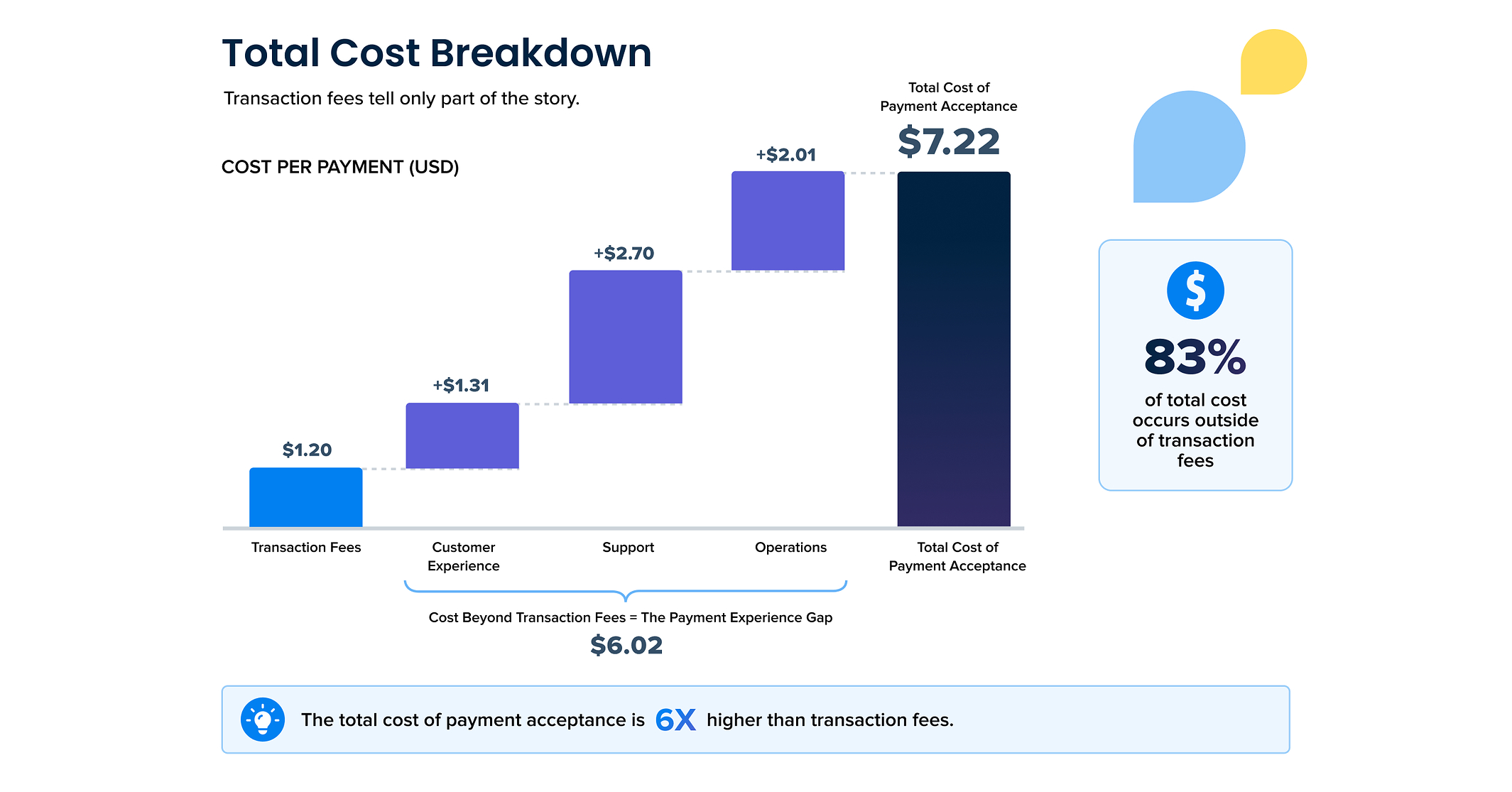
PayNearMe’s Payment Experience Gap report estimates the U.S. bill-pay market spends $100B+ annually on payment acceptance costs beyond transaction fees, with total cost ~6× higher than what bill-pay orgs typically measure. In a representative $640 payment case, total cost averages $7.22 per payment ($1.20 transaction fees plus $6.02 beyond fees), implying ~$3M in additional costs for a lender processing 500,000 payments/year, with support the largest driver at ~$2.70/payment.
This is less a payments breakthrough than a budgeting reframing: the real economic lever is not the interchange line item, it is the support, reconciliation, and abandonment drag layered on top of it. If buyers internalize that, the budget owner shifts from procurement to operations/collections, which tends to favor integrated payment-experience platforms over fee-only processors. The second-order effect is a gradual reallocation of volume toward higher-conversion rails and wallet options, even when they are not the cheapest on paper.
For public names, PYPL is the cleanest indirect beneficiary because it can argue that wallets reduce friction in bill pay, but the earnings impact is likely small until this shows up in actual TPV or merchant wins. AAPL and GOOGL get a much weaker read-through: they may capture incremental wallet usage, but bill pay is not a core monetization engine and the mix is unlikely to move EPS in the next few quarters. The losers are legacy servicing stacks and check/ACH-heavy workflows, but that pressure should be measured in share drift, not immediate disruption.
The catalyst path is months to years, not days. The main falsifier is if lenders find that wallet acceptance fees and implementation complexity offset the modeled support/ops savings, or if ACH modernization narrows return rates enough to shrink the gap. Contrarian view: the report may be directionally right but operationally over-aggregated, meaning it is more useful as a sales narrative for vendors than as a near-term market-moving signal.
AI-powered research, real-time alerts, and portfolio analytics for institutional investors.
Overall Sentiment
mildly positive
Sentiment Score
0.18
Ticker Sentiment
