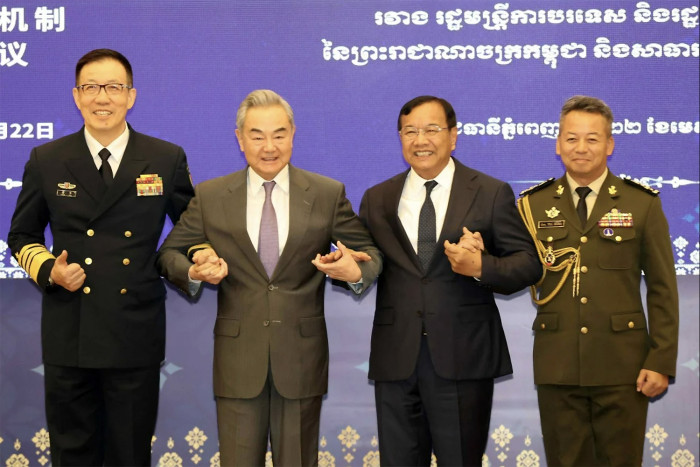
China and Cambodia elevated their strategic dialogue from 2+2 to 3+3, adding public security and interior ministries to deepen political and security cooperation. The article highlights Beijing's push to strengthen regional ties amid U.S.-China strategic competition, support Cambodia's crackdown on online scams, and manage tensions involving Cambodia's relations with Thailand. The tone is mostly diplomatic and factual, with limited direct market implications beyond broader geopolitical risk in Southeast Asia.
This is less about a ceremonial China-Cambodia upgrade and more about Beijing hardening its operating perimeter in Southeast Asia. The important second-order effect is that China is trying to reduce transaction costs in a region where it faces U.S. security pressure, supply-chain rerouting, and rising scrutiny of gray-zone financial flows; Cambodia becomes both a political proxy and a logistics node for future industrial relocation. That matters for industrials and infrastructure beneficiaries tied to Chinese capital deployment, but it also raises the probability of selective sanctions risk and reputational overhang for firms exposed to Cambodian state-linked projects.
The crackdown on telecom fraud is the most investable near-term catalyst because it can abruptly change cross-border capital and banking flows. If Phnom Penh is forced to keep delivering extraditions and asset seizures, the losers are organized-crime-linked cash businesses, shadow-payment intermediaries, and any residual gaming/property operators reliant on illicit liquidity; the winners are compliant banks, formal payments rails, and contractors with clean government sponsorship. The deeper point is that a cleaner enforcement regime may actually improve foreign-investor confidence, but only if it is perceived as durable rather than a one-off concession to Beijing, Washington, or Seoul.
For markets, the setup is asymmetric over months rather than days: no immediate macro shock, but rising tail risk around policy alignment, military basing rumors, and Thailand border stability. A sustained tightening of China-Cambodia security ties increases the odds of friction with the U.S. and maybe EU, but the more immediate market impact is on Cambodian sovereign risk premiums and on companies with manufacturing or sourcing exposure that depend on stable regional transit. Conversely, any credible U.S.-Cambodia thaw would be a negative signal for the depth of Beijing's leverage and could ease sanction-risk pricing on local projects.
The contrarian view is that the consensus is overestimating militarization and underestimating enforcement normalization. Ream may remain more symbolic than operational, while the scam-crackdown and extraditions could be a genuine governance upgrade that supports capital formation and non-China FDI. That makes this a better relative-value than directional geopolitics trade: the main opportunity is to own beneficiaries of formalization while avoiding names whose economics depend on opaque flows or discretionary political protection.
AI-powered research, real-time alerts, and portfolio analytics for institutional investors.
Request TrialOverall Sentiment
neutral
Sentiment Score
0.05
