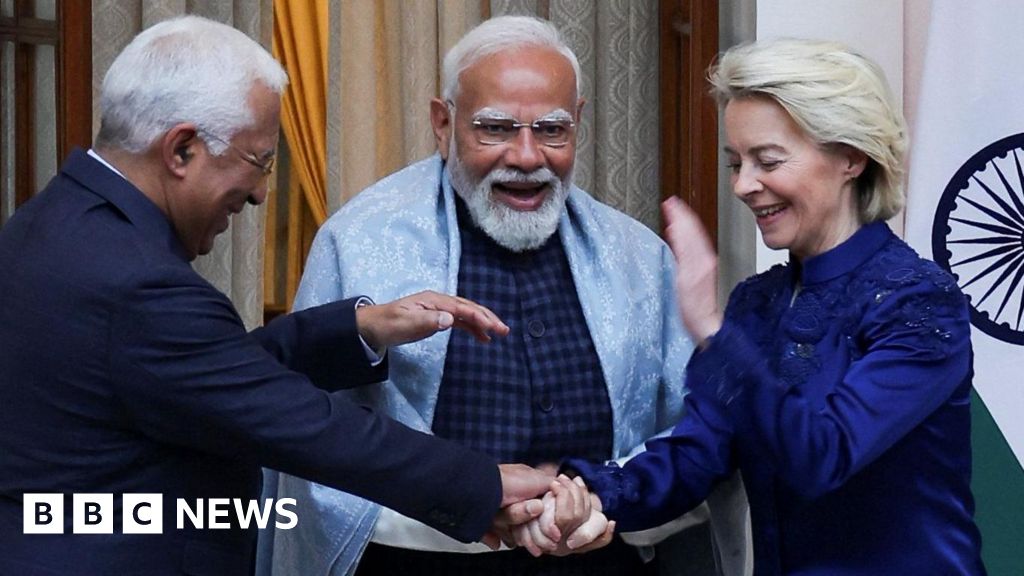
India and the EU reached a landmark trade agreement that would deepen ties between the bloc and India — the EU was India’s largest goods partner at $142.3bn in 2024 (11.5% of India’s trade) — but the pact still requires lengthy legal finalisation and ratification. The deal is driven in part by geopolitical hedging against unpredictable US tariff threats (including recent US tariffs and threats linked to Indian purchases of Russian oil) and aims to diversify supply chains and defence procurement away from traditional partners; key outstanding issues include intellectual property, agriculture and carbon rules and possible legal hurdles similar to the Mercosur saga.
Market structure: The India–EU FTA is a win for export-heavy Indian sectors (textiles, gems, pharmaceuticals, IT services) and EU capital goods, aerospace/defence and luxury goods — expect incremental market-share shifts from China to India in labour‑intensive and pharma supply chains over 12–36 months. Pricing power will tilt toward Indian exporters (higher volumes) and specialised European suppliers (defence, high-end manufacturing); shipping and logistics capacity serving India–EU lanes should see utilisation lift, pressuring container rates upward episodically.
Risk assessment: Tail risks include US retaliatory tariffs or secondary sanctions (low probability but severe — >25–100% tariffs would shock flows) and EU ratification failure (10–30% chance within 12 months). Immediate (days) volatility likely muted; short term (3–12 months) is governed by legal text finalisation and parliament votes; long term (2–5 years) is supply‑chain realignment benefitting capex and raw-material demand. Hidden dependencies: India’s continued Russian oil imports keep US leverage alive and can trigger secondary actions.
Trade implications: Tactical long India exposure (equity ETFs, selective large caps) vs short China exporters is attractive: relative-value should play out over 6–24 months as sourcing shifts. Fixed income/currency: anticipate gradual INR strength vs USD/EUR over 12–36 months — favour long INR exposure via forwards or INR‑linked debt. Commodities: overweight industrial metals (copper, steel inputs) as Indian manufacturing ramps.
Contrarian angles: Consensus underprices ratification risk and US political tail-risk; markets may underreact to near-term regulatory drag while overpricing long-term seamless re-shoring. A mispriced outcome: Indian equity rerating could be underdone (look for 10–25% upside vs China if ratification proceeds), but if US imposes broad tariffs the opposite could unwind quickly.
AI-powered research, real-time alerts, and portfolio analytics for institutional investors.
Request DemoOverall Sentiment
neutral
Sentiment Score
0.12
