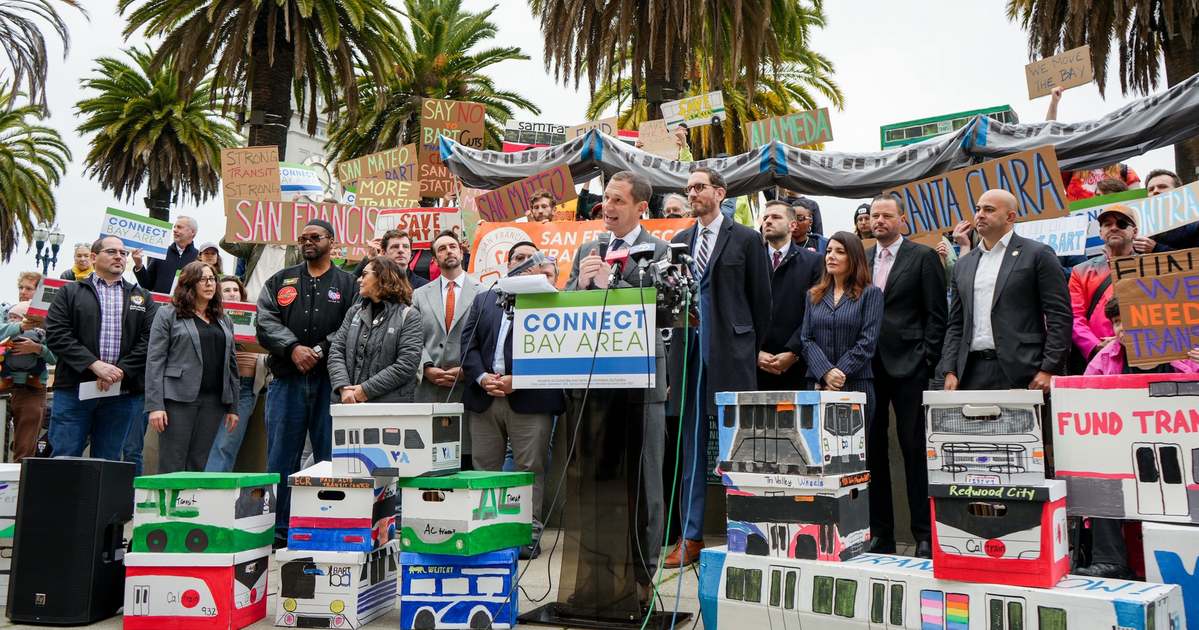
Bay Area transit agencies face severe funding pressure, with BART citing a roughly $350 million operating deficit, Muni a $307 million shortfall that could widen to $434 million, and Caltrain warning it could shut down by 2029 without new revenue. A regional 0.5% sales tax measure, backed by 305,895 signatures and supported by more than 80 elected officials, is virtually assured of ballot qualification and aims to raise nearly $1 billion annually. If the tax fails, service cuts could be substantial, including BART station closures and up to 70% service reductions, making the November vote a key funding and political event.
The market implication is less about the ballot math and more about a near-term reduction in bankruptcy-style overhang for Bay Area mobility. If the measure clears, it likely stabilizes agency cash flow for 12-24 months, which should compress tail-risk pricing in commuter-sensitive assets such as downtown retail, office, and last-mile logistics; if it fails, the adjustment will be abrupt and highly nonlinear, with transit-dependent corridors seeing the sharpest revenue shock. The key second-order effect is that the region’s labor market could reprice around reliability rather than commute time, reinforcing hybrid work and structurally capping weekday volumes even if headline service survives.
For UBER, the direct read is modestly positive but not linear: weaker rail/bus coverage increases short-haul rides, airport transfers, and multimodal substitution, especially in outer-county nodes where transit cuts are most acute. The bigger opportunity is on the margin of network effects—each cut to service makes the car the default for a slice of demand that is currently elastic, which supports utilization and pricing in dense corridors without requiring a broad consumer spending uplift. That said, a funded transit backstop would delay this effect and keep rideshare demand from becoming a true structural winner in the near term.
The contrarian angle is that the “fear campaign” may have pulled forward support, but implementation risk is not binary: validation, county-by-county compliance, and subsequent political bargaining can still create a gap between ballot qualification and durable revenue. More importantly, even a successful tax does not solve the underlying ridership mix problem; it may preserve service levels while entrenching low-return routes, meaning agencies could still be back in the same funding hole in 2-4 years. That makes the trade asymmetry better in the six-to-twelve-month window than in a multi-year horizon.
AI-powered research, real-time alerts, and portfolio analytics for institutional investors.
Request DemoOverall Sentiment
mildly negative
Sentiment Score
-0.15
Ticker Sentiment
