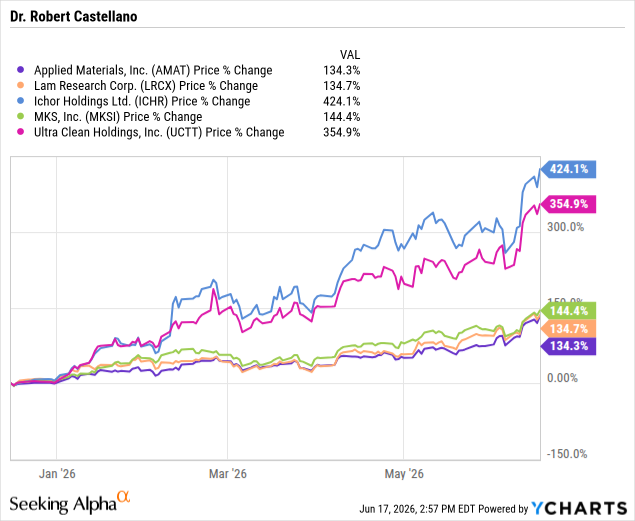
Ultra Clean Holdings received multiple bullish analyst actions, including Needham and TD Cowen raising price targets to $70 from $50 and $35, respectively, while Oppenheimer reiterated Outperform and lifted its target on strong guidance. The article argues that WFE spending is expected to grow 15%–20%, supporting supplier demand, but concludes that Applied Materials and Lam Research have historically captured more value and delivered stronger long-term returns. Overall, the piece is constructive for semiconductor equipment and supply-chain names, but it is primarily analytical rather than a direct catalyst.
The key second-order read is that this is not just a “semicap upcycle” story; it is a margin-location story. The tools OEMs own the interface to the fab, so they are the choke point for pricing, service attach, and roadmap capture, while suppliers get the cyclical beta without the economic rent. That asymmetry tends to widen in the first 2-3 quarters of an upcycle because build rates inflect faster than pricing power for sub-tier vendors, which is why the market usually re-rates AMAT/LRCX before it fully rewards UCTT/MKSI/ICHR.
UCTT is the cleanest near-term beneficiary because the analyst revisions are pointing to a stronger order book, but it is also the most vulnerable to a “good news, weak multiple” setup if investors extrapolate 15%-20% growth without a sustained margin step-up. The highest-quality signal to watch is not revenue growth but mix and utilization: if leading-edge logic/HBM demand is real, the operating leverage should show up first in suppliers with the most differentiated content, not the broadest exposure. That argues for being selective inside the supplier basket rather than owning the group wholesale.
The contrarian miss is that the bigger OEMs may actually get more incremental value from this cycle than the market is pricing, because their installed base and service revenue give them a cushion if WFE normalizes faster than expected. Meanwhile, smaller suppliers remain exposed to order pushouts and customer concentration if one or two tool ramps slip by a quarter. Over the next 3-6 months, the risk is that the market front-runs the 2026 guide language and then stalls until actual fab capex converts into shipment data.
AI-powered research, real-time alerts, and portfolio analytics for institutional investors.
Request DemoOverall Sentiment
mildly positive
Sentiment Score
0.35
Ticker Sentiment
