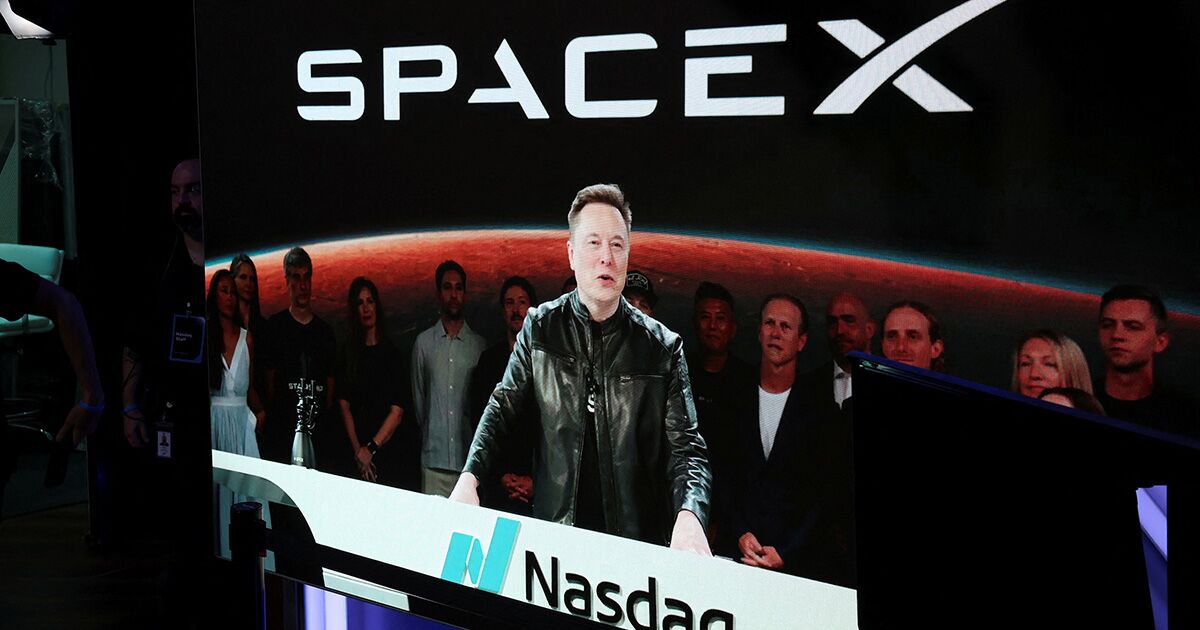
SpaceX went public on June 12 and closed with a $2.1 trillion market capitalization, making Elon Musk roughly 40% owner of a company valued at about $840 billion. The filing says SpaceX has three businesses—rocket launches, satellite internet, and AI hardware/software—and pegs total addressable market at $28.5 trillion, including $26.5 trillion from space-based data centers. The article is largely narrative, but the scale of the IPO and valuation is notable for investor sentiment around private-market tech and AI.
The first-order reaction is to treat the SpaceX debut as a pure Musk beta event, but the more important read-through is that it re-prices the entire “private-to-public via ecosystem” model. If a trillion-plus, narrative-driven asset can clear at scale, the marginal cost of capital for Musk-adjacent ventures falls, while the market’s tolerance for low-current-earnings, high-TAM storytelling rises across frontier tech. That usually benefits TSLA sentiment in the near term, but it also raises the bar for execution: any slowdown in Tesla margins or autonomy milestones will be judged against an even more liquid, more visible capital-marking machine.
For PYPL, the impact is subtler and probably smaller than the headline suggests, but the second-order effect is governance compression. Investors are being reminded that founder control plus a dominant ecosystem can create enormous equity value, which makes PYPL’s more conventional fintech profile look comparatively ex-growth and less optionality-rich. That can keep a valuation discount in place for months unless management can re-accelerate take-rate or prove meaningful operating leverage.
The main contrarian risk is that the market is extrapolating TAM rather than cash flow. Space/data-center-in-orbit economics are years from being de-risked, and if financing or launch cadence disappoints, the stock can de-rate fast because a large part of the valuation rests on long-duration assumptions. For TSLA holders, the biggest risk is not direct competition from SpaceX, but capital allocation fatigue: investors may demand clearer separation between “vision premium” and actual free cash flow conversion across the Musk complex.
Catalyst-wise, the next 1-3 months matter most for sentiment, not fundamentals: any follow-on financing, secondary liquidity event, or regulatory filing can extend the momentum trade. Over 6-18 months, the critical variable is whether SpaceX monetizes beyond launches into recurring software/network revenue; if not, the current multiple is vulnerable to a 20-30% reset on a normal rate-driven de-rating.
AI-powered research, real-time alerts, and portfolio analytics for institutional investors.
Request DemoOverall Sentiment
mildly positive
Sentiment Score
0.22
Ticker Sentiment
