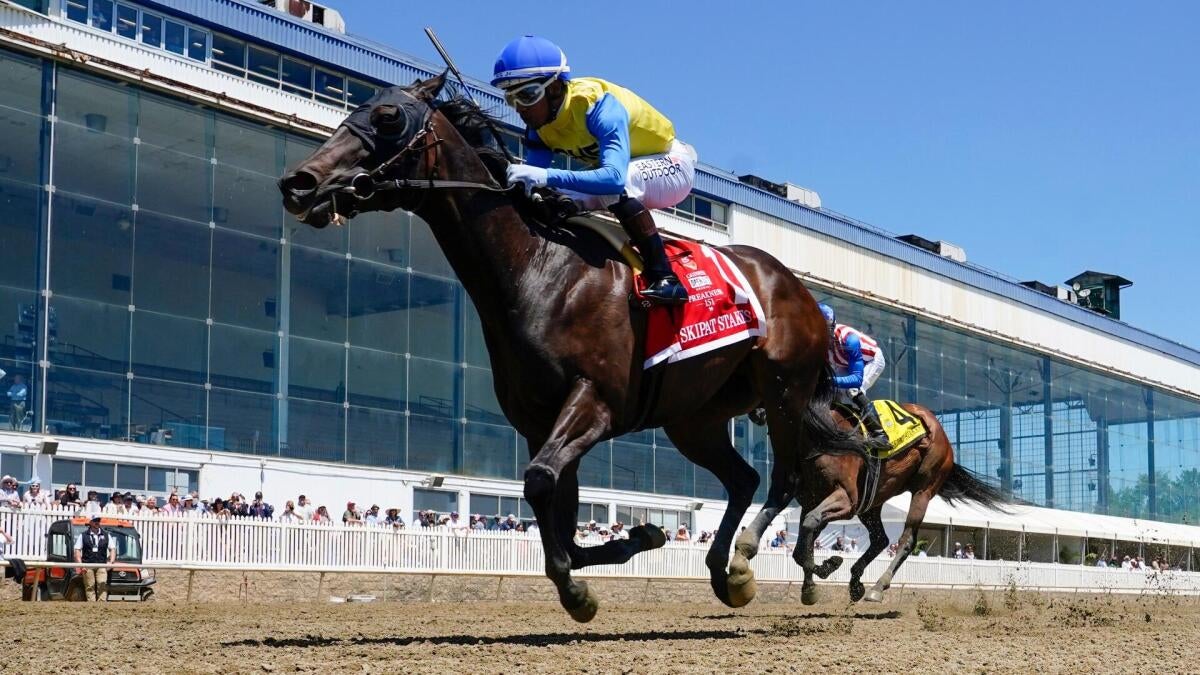
The article is a preview of the 2026 Preakness Stakes, highlighting a 14-horse field, a 7:01 p.m. ET post time, and Iron Honor as the 9-2 morning-line favorite. It also notes several key contenders at 5-1, including Taj Mahal, Chip Honcho and Incredibolt, while tipster Jody Demling is backing Napoleon Solo at 8-1 and fading Chip Honcho. The piece is primarily race-betting commentary and has minimal direct market relevance.
The setup is a classic volatility event rather than a clean directional trade: a large, evenly priced field increases upset probability and reduces the value of the favorite-tax that usually shows up in short fields. That matters less for the race itself than for the betting ecosystem around it — pools, ADW handles, and promo-driven acquisition activity should skew higher than a normal Preakness weekend because uncertainty tends to lift turnover and encourage more multi-race wagering.
From a market-structure lens, the most interesting second-order effect is not the winner but the underexploited dispersion across contenders. When no horse is clearly dominant, public money typically overweights obvious narratives and post-position heuristics, creating mispricing in exactas/trifectas and in longshot coverage. The practical edge is to fade the “two or three names everyone can explain” and instead build around one overlooked pace/midpack horse plus one price horse that benefits if the pace collapses.
The contrarian risk is that broader interest in a wide-open field can compress exotics payouts if casual bettors pile into boxed combinations, even if the winner is a price. That means the best expected value is likely in selective structures rather than broad coverage. Time horizon is purely event-driven: the edge exists only into post time, and the main reversal catalyst is late tote-board steam into the same obvious runners the article already highlights as public-facing favorites.
For media and fantasy-style betting partners, this kind of race supports engagement and conversion, but it is not a durable fundamental signal. The actionable takeaway is to treat this as a short-dated volatility pocket where information asymmetry is highest in the final 30-60 minutes before the race, not days earlier.
AI-powered research, real-time alerts, and portfolio analytics for institutional investors.
Request DemoOverall Sentiment
neutral
Sentiment Score
0.05
