

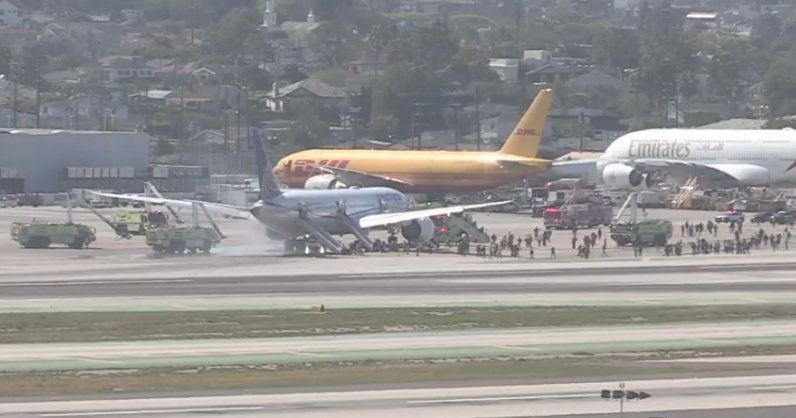
United Airlines Flight 2127, a Boeing 787-9 departing LAX for Newark, returned to make an emergency landing at about 11:19 a.m. local time after crews observed a left-engine smoking and passengers evacuated via slides; no passengers required hospitalization. The FAA issued and briefly held a ground stop at LAX and is investigating the engine fire; United said customers were bused back to the terminal and praised crew actions. The incident presents operational disruption and potential short-term reputational risk for the carrier (and attention to Boeing equipment), but with no injuries reported and an investigation pending, material market impact is likely limited.
Market structure: Immediate winners are competitors with flexible schedules (e.g., DAL, AAL) who can capture rebookings; direct loser is UAL (reputational + operational disruption). Expect a discrete equity reaction for UAL of roughly -1% to -4% intra‑day and a 15%–40% jump in UAL option implied volatility over 24–72 hours; airline demand fundamentals (seasonal leisure travel) are unchanged so long‑run revenue pressure is limited. Cross‑asset: UAL credit spreads could widen 5–25 bps near term; oil/FX impact is negligible.
Risk assessment: Tail risks include an FAA/NTSB finding that forces fleet inspections or temporary groundings (low probability, high impact) which could raise UAL maintenance/O&M costs by ~2%–5% annually and shave 3–7% off EPS for a quarter. Time horizons: immediate (0–7 days) = reputation/IV shock; short (1–8 weeks) = booking flow, preliminary probe; medium (3–9 months) = regulatory changes/inspections if structural issues found. Hidden dependencies: engine OEM liability, insurer reserve actions, and lease maturities that could amplify financial pain.
Trade implications: Tactical trades should be short UAL equity/long put exposure into the 1–6 week window while buying optionality to cap downside; consider pair trades long Delta (DAL) vs short UAL for relative safety. If IV spikes >25% from baseline, favor defined‑risk put spreads to control gamma; avoid seizing on Boeing (BA) until FAA/NTSB signals linkage to airframe – wait 30–60 days. Sector rotation: trim concentrated UAL exposure in travel ETFs and redeploy 1%–3% into higher‑quality carriers and travel beneficiaries (airports, booking platforms).
Contrarian angles: Consensus will trade on fear; missing is that quick, injury‑free evacuations and pilot response reduce long‑term demand shocks — if NTSB/FAA find no systemic defect, IV and price should mean‑revert within 7–21 days. Historical parallels (isolated engine/engine‑fire events) show single‑incident equity hits of 3%–8% that recover within 1–3 months absent regulatory action. Unintended consequences: over‑shorting UAL preemptively risks a sharp squeeze if guidance and pax confidence hold.
AI-powered research, real-time alerts, and portfolio analytics for institutional investors.
Request TrialOverall Sentiment
moderately negative
Sentiment Score
-0.25
Ticker Sentiment
