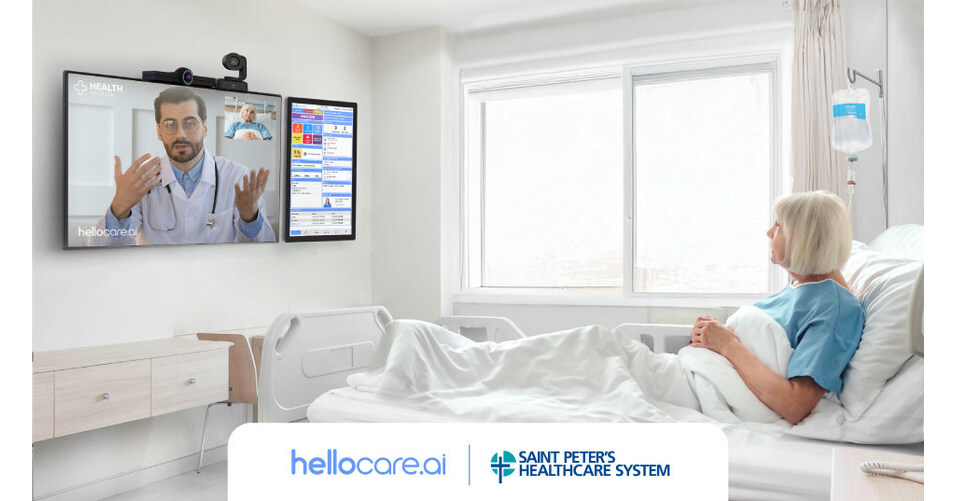
hellocare.ai said Saint Peter's Healthcare System expanded deployment of its intelligent hospital room platform, building on AI Assisted Virtual Nurse Rounding/Telehealth and Virtual Sitting. Saint Peter’s is now live with hellocare.ai AI models for fall prevention and is rolling out real-time digital door signs to display critical patient and operational information outside rooms. The company reports meaningful early improvements in patient experience and reduced patient safety risks, with no quantified financial impact disclosed in the release.
This is better read as a proof-of-concept for hospital workflow automation than a standalone revenue event. The economic value accrues to the operator that can cut sitter hours, reduce adverse events, and lower nurse churn; that favors integrated platforms with real workflow hooks over point-solutions that only brand themselves as “AI.” Public-market beneficiaries are better framed as hospital IT and monitoring proxies such as GEHC, ORCL, and MASI, while staffing proxies like AMN could see incremental pressure if virtual observation substitutes for contract labor.
Near term, the market should mostly shrug: one expanding deployment does not validate enterprise conversion, pricing power, or a material ARR ramp. The real catalyst is quantified ROI—fall-rate reduction, fewer overtime hours, shorter length of stay, or lower agency spend—because CFOs will not scale pilots without hard before/after data. Falsifiers are simple: no measurable safety improvement, implementation friction at the bedside, or budget deferrals if reimbursement and capex discipline tighten.
The contrarian miss is that investors may overpay for the “AI” label while underestimating the slow, operational nature of the win. If this category works, the second-order effect is not just monitoring automation; it is a gradual reallocation of hospital spend away from labor and toward software that integrates with the EHR and nursing workflows, which is why distribution-heavy vendors should outcompete niche startups. Over 6-18 months, the thesis weakens quickly if nursing shortages ease or if hospitals find the workflow burden offsets the labor savings.
AI-powered research, real-time alerts, and portfolio analytics for institutional investors.
Request DemoOverall Sentiment
mildly positive
Sentiment Score
0.25
Ticker Sentiment
