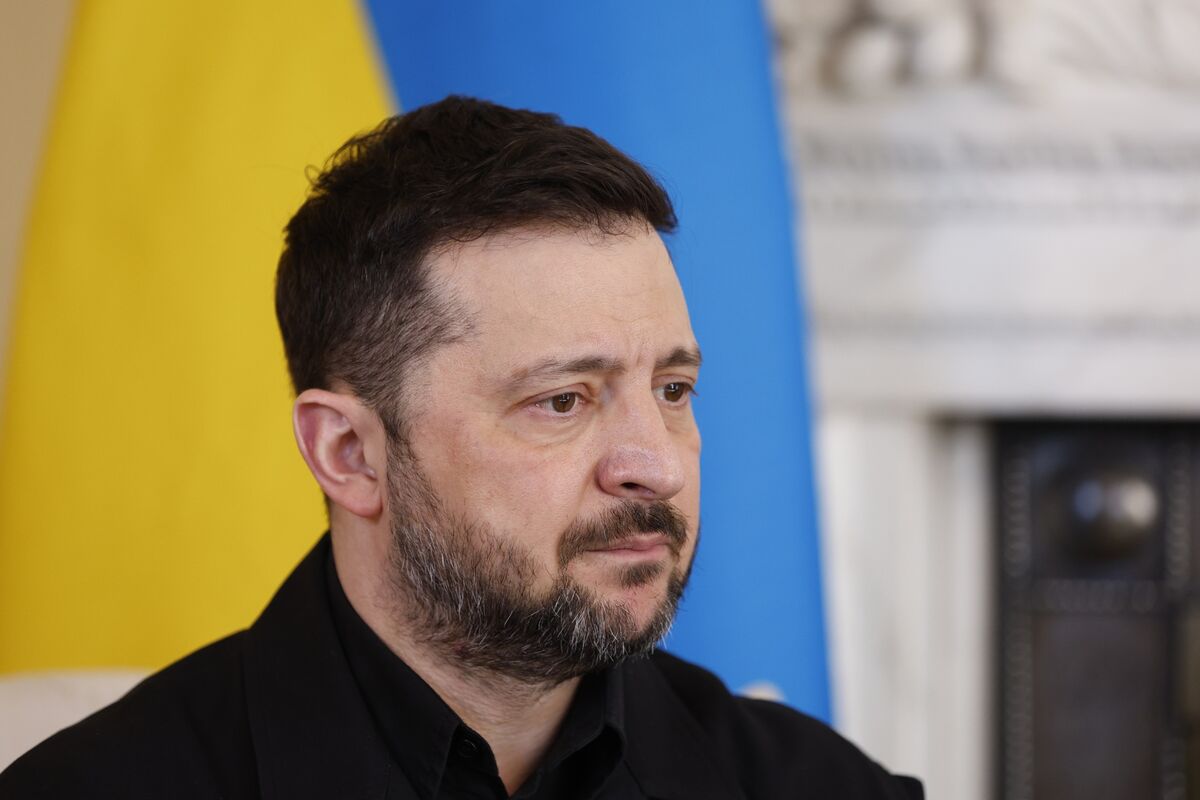
Ukrainian President Volodymyr Zelenskyy approved a 40-day campaign aimed at influencing Russia to end the war, following a briefing on strikes against Russian targets. The plan was not detailed, but Zelenskyy highlighted the role of Ukraine’s security services and drones in defending frontline positions. The report is geopolitically relevant but contains no direct market-moving economic or company-specific developments.
This reads less like an immediate market event and more like a signal that Ukraine is trying to raise the perceived cost of Russian persistence through asymmetric pressure. The near-term beneficiaries are defense electronics, drone component suppliers, ISR software, and hardened communications vendors; the losers are any exposed logistics nodes, commodity transport assets, or industrial infrastructure in the western theater that become more targetable. The second-order effect is a further premium on redundancy: firms with distributed production, dual-source suppliers, and strong physical security should see relative multiple support versus peers with concentrated assets.
The key market implication is not directionally higher defense spending alone, but a faster mix shift toward low-cost precision systems and counter-UAS. That usually compresses procurement cycles for drones, sensors, EW, and battlefield networking while pressuring legacy heavy-platform contractors to justify relevance. If this campaign increases strike frequency or visible damage, expect governments and corporates in adjacent regions to accelerate hardening capex over the next 1-3 quarters, especially around energy, rail, ports, and telecom.
Tail risk is escalation: a successful pressure campaign could provoke broader retaliation, while an ineffective one could reinforce a stalemate narrative and reduce urgency for incremental aid. The base case is higher volatility rather than a clean trend change; the trade works best over days to weeks if markets start discounting a larger, more persistent attritional phase. What consensus may miss is that uncertainty itself is monetizable for the defense/security stack, even absent a major battlefield shift: procurement often follows the perception of adaptation more than the outcome of any single operation.
AI-powered research, real-time alerts, and portfolio analytics for institutional investors.
Request DemoOverall Sentiment
neutral
Sentiment Score
-0.10
