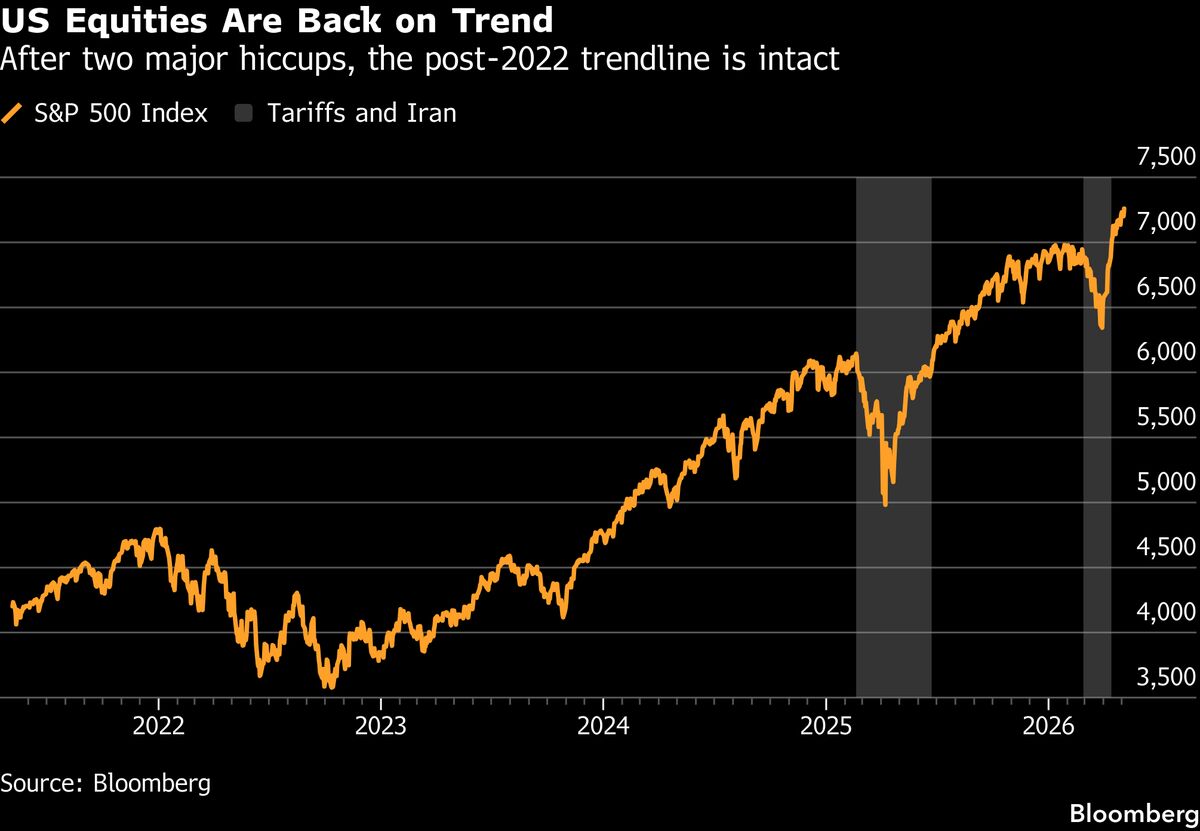
US equities may be losing the broad market support that megacap tech has provided, with the Nasdaq 100 up more than 20% from March 30 after a mild decline earlier in the period. The article argues that the next leg higher will require a wider set of drivers, plus real progress on the war front, to be sustained. This is a cautionary message for market breadth and sentiment rather than a direct company-specific catalyst.
The market has become increasingly hostage to a narrow leadership regime, which is mechanically fragile: once a small cohort of mega-cap growth names stops compounding at the same pace, index-level returns can de-rate quickly even if breadth merely normalizes rather than deteriorates. That creates a hidden air pocket for passive and systematic flows, because many trend and risk-parity models are effectively long the same crowded factor stack. The second-order effect is that under-owned cyclical and defense pockets can outperform on a relative basis even in a flat index tape, as allocators look for earnings revisions outside the expensive duration trade.
Geopolitical upside from headline de-escalation is asymmetric but not immediately monetized unless it improves discount rates and commodity volatility at the same time. The market is currently pricing a binary “no worse than expected” outcome; if the conflict remains contained, equities can keep grinding, but the next leg higher likely requires better breadth, not just lower event risk. If the situation deteriorates, the first casualties are high-multiple growth and semis, where even a modest multiple reset can overwhelm still-strong fundamentals.
The contrarian read is that the rally may be both more resilient and more vulnerable than consensus thinks: resilient because earnings power in the megacaps still acts as a natural buyer of index weakness, vulnerable because that support is now well-understood and crowded. A broadening trade usually starts with a rotation out of the most consensus-owned winners into stale, balance-sheet-safe cyclicals and quality value, not with a macro breakout. That makes the next few weeks a timing game around breadth confirmation rather than a simple risk-on/risk-off call.
AI-powered research, real-time alerts, and portfolio analytics for institutional investors.
Request DemoOverall Sentiment
mildly negative
Sentiment Score
-0.15
