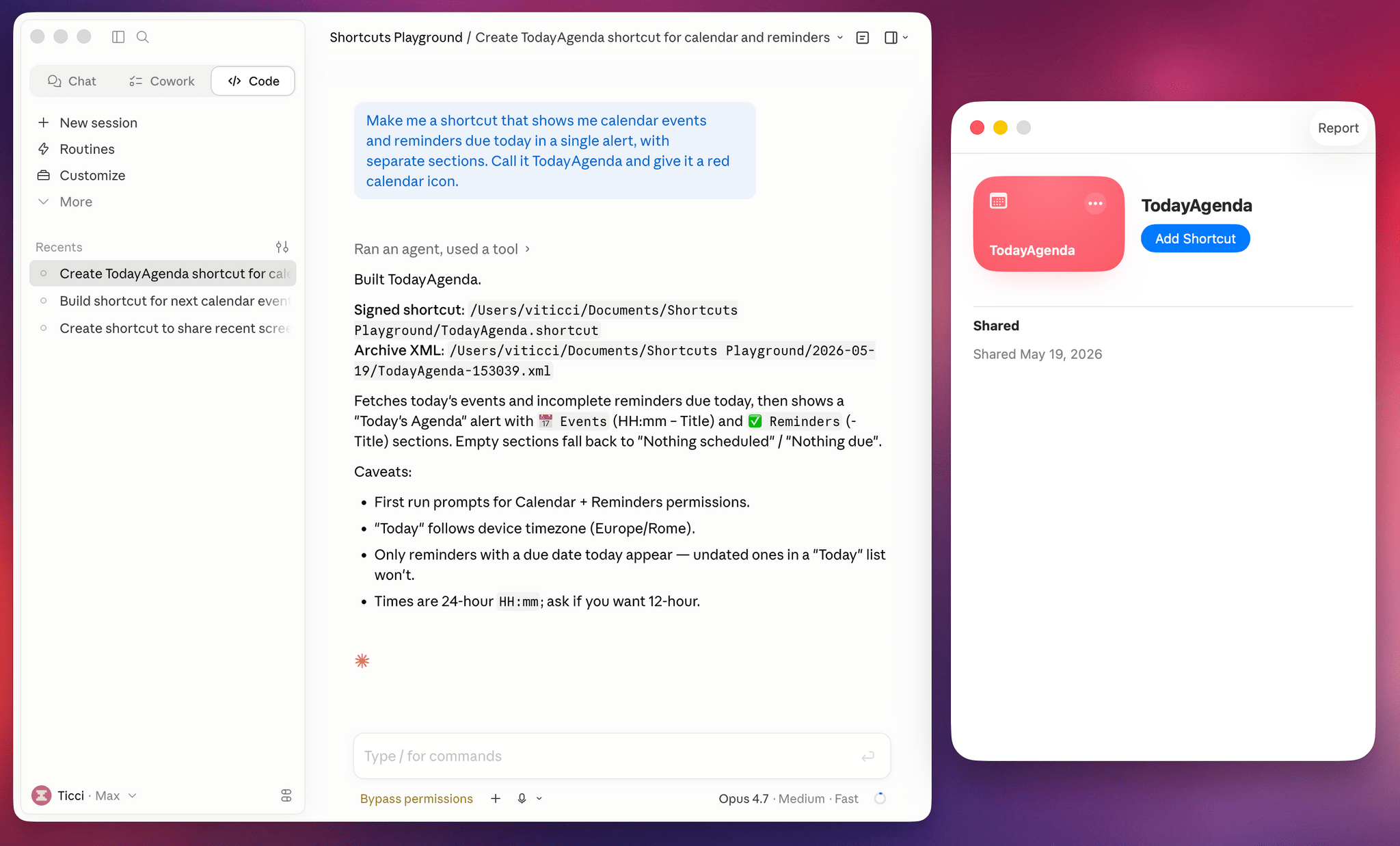
MacStories launched Shortcuts Playground, a free open-source plugin for Claude Code and Codex that uses natural language to generate Apple Shortcuts and outputs signed .shortcut files for import on Mac, iPhone, and iPad. The tool includes validation loops, support for /build and /remix workflows, and a redesigned Shortcuts Archive with 100 AI-generated shortcuts. The article frames the product as a democratization of automation, though it also notes output must still be reviewed for accuracy.
AAPL is the real beneficiary here, but not because this tool directly drives revenue. The second-order effect is that it lowers the friction to building high-value automations inside the Apple ecosystem, which deepens device stickiness and raises switching costs at the margin; that matters more in Services than in hardware. If generative Shortcuts becomes a native capability, Apple gets a low-cost feature that can quietly expand iPhone/iPad utility without materially increasing capex, which is structurally positive for ecosystem retention.
The bigger near-term implication is competitive, not monetization: this is a proof-of-concept that consumer software workflows are becoming agent-mediated, and Apple is now more exposed to being outrun on developer experience than on core OS features. The article effectively advertises a latent gap in Apple’s own product stack: if an outside operator can reverse-engineer and package this, Apple’s internal teams likely have a path to ship a safer, more integrated version within 12-18 months. That creates a classic fast-follow risk for the open-source creator, but a positive optionality setup for Apple if the feature lands as a native intelligence layer.
RDDT is a quieter beneficiary through engagement, not direct linkage. The open-source/DIY distribution loop relies on community troubleshooting, examples, and iterative prompt-sharing, which tends to increase forum activity around niche technical ecosystems; that can support sticky, high-intent discussion traffic. The contrarian risk is that if Apple ships a native version quickly, the creator-led distribution and surrounding community enthusiasm may peak early and fade, compressing the lifetime value of this launch.
The main tail risk for AAPL is not adoption failure but trust: any publicized shortcut error that causes data leakage, unintended automation, or a bad user outcome would reinforce the notion that Apple needs guardrails before scaling this category. Near term, expect limited fundamental impact; over months, the setup is about platform narrative and incremental services attachment, not immediate earnings revision.
AI-powered research, real-time alerts, and portfolio analytics for institutional investors.
Request DemoOverall Sentiment
mildly positive
Sentiment Score
0.35
Ticker Sentiment
