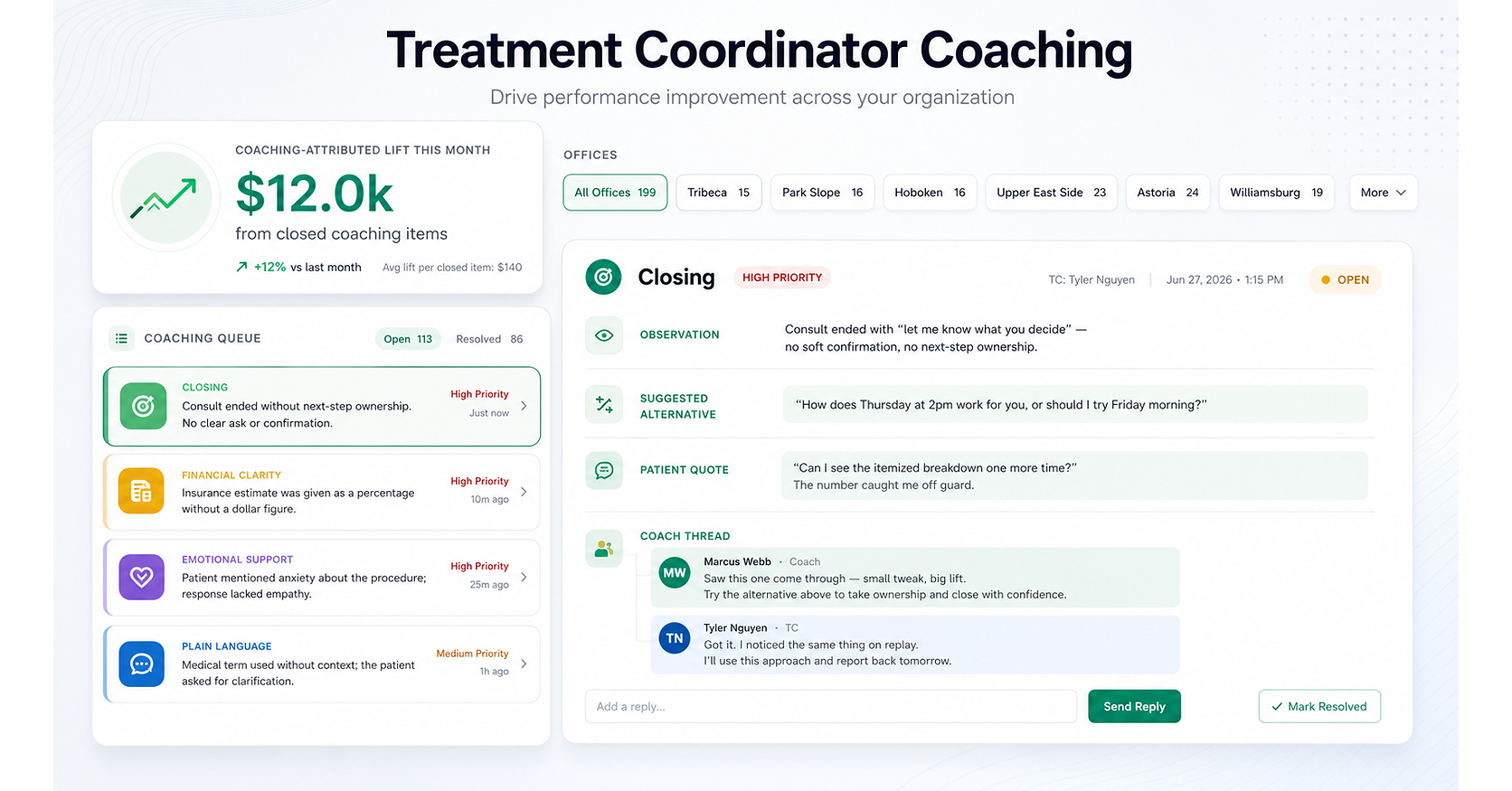
DentScribe (AI for dental documentation) launched two new capabilities—DentScribe Patient Profiles and DentScribe Treatment Coordinator Intelligence—to standardize SOAP-note-to-financial-conversation workflows across DSOs and multi-location groups. The Patient Profiles module (in DentScribe CoPilot) flags care follow-up needs and patient communication cues from prior SOAP evidence, while Treatment Coordinator Notes generate structured summaries of financial objections, options, and next steps. The company positions the tools as measurable “missing link” to improve case acceptance and coach coordinators for clearer, more consistent financial discussions across locations.
This is directionally positive for the DSO software stack, but the public-market read-through is thin until the product is tied to audited uplift in production per chair or lower chair-side labor. The first-order beneficiary is centralized operators that can standardize sales and coaching; the second-order winner could be the dental supply chain if better conversion turns deferred restorative and elective cases into real procedures. That said, if the lift is mostly documentation automation, the economic value accrues to labor efficiency rather than top-line growth.
The competitive angle is more important than the product pitch: workflow AI that sits between the operatory and the business office can become sticky because it captures process data across locations. That creates pressure on incumbent practice-management vendors and manual coordinator workflows, but only if integrations are deep and implementation friction is low. Near term, this is a pilot-and-proof story, not a revenue inflection story.
The main risk is overestimating willingness-to-pay. In dental, case acceptance is usually constrained by insurance mix, affordability, and capacity, so improved scripting may simply shift timing rather than net demand. Over 1-3 months, the key catalyst is third-party evidence of conversion-rate improvement at multi-location groups; over 6-18 months, the question is whether this becomes a standard layer in DSO operations or remains a niche add-on.
Consensus is likely missing how modest the public-equity impact is absent a named channel partner or measurable customer footprint. The overdone view is treating any AI in healthcare ops as automatically margin-accretive; the underdone view is that a handful of large DSOs could adopt this as a centralized quality-control layer, which would favor scale operators over mom-and-pop practices. No direct trade is compelling today without adoption data.
AI-powered research, real-time alerts, and portfolio analytics for institutional investors.
Request DemoOverall Sentiment
mildly positive
Sentiment Score
0.18
Ticker Sentiment
