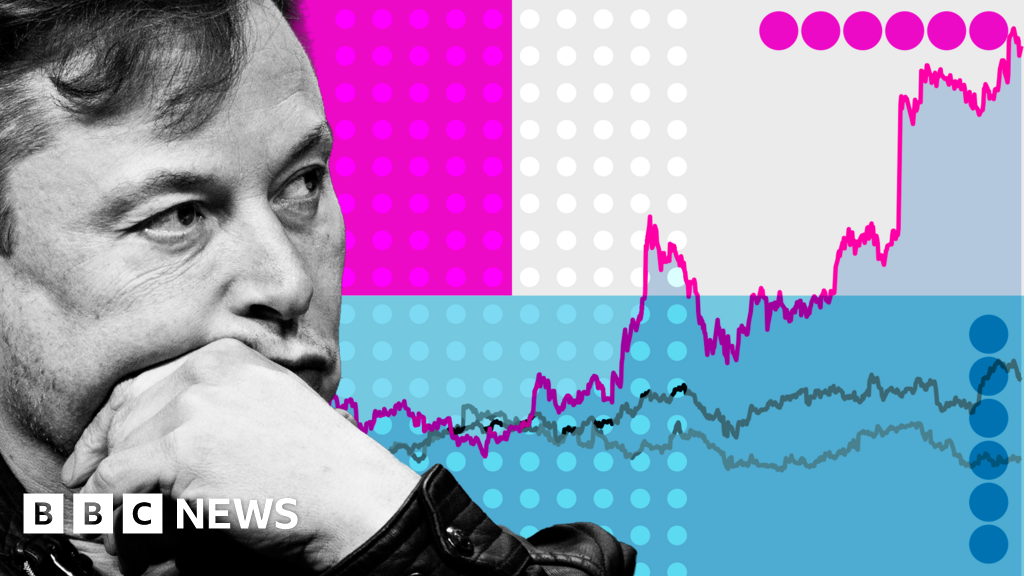
Elon Musk became the world's first trillionaire, with Bloomberg estimating his net worth at about $1.11tn, driven primarily by a 12% stake in Tesla and a 42% stake in SpaceX. The article highlights how his wealth surged from roughly $28bn in January 2020 to $1tn+, despite volatility tied to Tesla, SpaceX valuations, and political sentiment. While notable for sentiment around Musk, the piece is largely a descriptive wealth-profile update rather than a direct market-moving event.
The market is increasingly pricing founder optionality as a first-class asset class, not a footnote. When a single individual’s paper wealth is dominated by two public/private holdings, the marginal driver of incremental wealth is not earnings quality but liquidity conditions, lock-up perception, and the market’s willingness to underwrite duration on very large asset bases. That creates a reflexive loop: higher valuations improve collateral capacity and strategic credibility, which can support more risk-taking and further upside in the underlying names.
For TSLA, the key second-order effect is that the stock is no longer trading only on vehicle demand or margins; it is trading on the market’s tolerance for a “platform premium” tied to AI, autonomy, and adjacent venture optionality. That makes the name unusually sensitive to shifts in growth-factor leadership and to any crack in megacap tech sentiment over the next 1-3 months. If that premium compresses, the downside can be disproportionate because so much of the ownership base is anchored to a narrative of compounding optionality rather than near-term fundamentals.
The broader winners are private-market and late-stage frontier tech assets, which benefit from the signaling effect of a new public-market benchmark for extreme founder wealth. The losers are traditional industrial and consumer sectors that remain structurally under-owned as capital continues to concentrate in a narrow tech cohort. A contrarian read is that this concentration is itself a warning sign: when the richest-person leaderboard is dominated by a handful of correlated tech assets, the market is implicitly pricing low dispersion and high policy tolerance, both of which can reverse quickly if rates, antitrust, or political scrutiny tighten.
AI-powered research, real-time alerts, and portfolio analytics for institutional investors.
Request DemoOverall Sentiment
mildly positive
Sentiment Score
0.35
Ticker Sentiment
