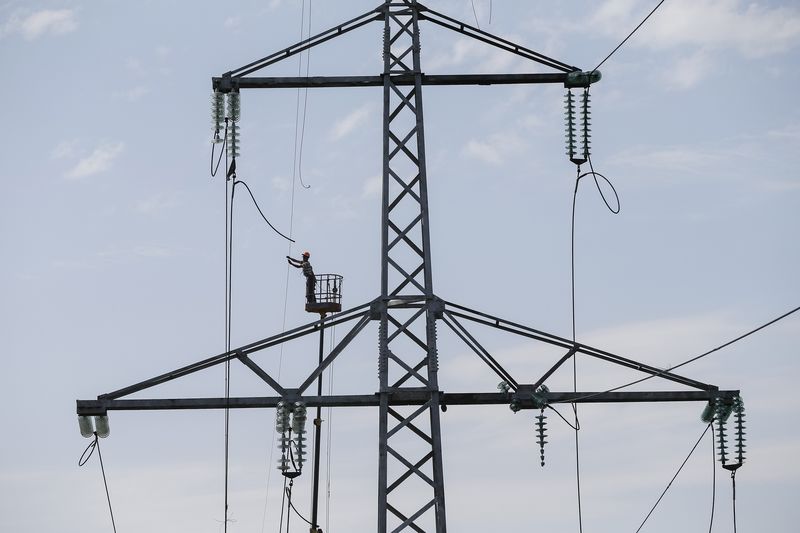
Bank of America highlighted 10 data-center infrastructure beneficiaries, spanning utilities, power generation, battery storage, and industrial equipment, with the list covering rankings 1 through 10 in this segment of 67 stocks. The article also notes mixed company-specific updates, including GE Vernova collaboration news, Caterpillar's 20% EPS beat, and Sempra, DTE, Evergy, and Talen Energy reporting results that were generally supportive but not transformative. Overall the piece is a stock-selection and sector-positioning note tied to AI-driven data center demand rather than a single market-moving event.
The market is still pricing the AI buildout as a pure semiconductor story, but the marginal beneficiary set is shifting into the bottleneck layer: power, standby generation, grid equipment, and utility interconnects. That matters because these businesses convert backlog into earnings with a lag, so the earnings impulse should show up over the next 4-8 quarters rather than immediately in headline AI spend. The second-order winner is not necessarily the largest utility exposure, but the companies with pricing power in constrained categories like turbines, switchgear, transformers, and backup systems.
The clearest relative-value tension is that some of the best positioned names are still being valued like cyclical industrials or regulated utilities despite having quasi-infrastructure scarcity characteristics. CAT and GEV look like the highest-quality proxies for data-center capex because they can monetize both construction and uptime requirements, while the utility names are more dependent on rate cases and permitting. That creates an important spread trade: the market may overpay for obvious AI beneficiaries higher up the stack while underappreciating the operating leverage embedded in less crowded picks.
The main risk is that AI infrastructure demand gets pushed out rather than canceled. Power interconnects, gas turbine lead times, transformer shortages, and siting approvals can defer revenue recognition by 12-24 months, which hurts near-term sentiment even if the long-term demand remains intact. A reversal would likely come from either a sharp fall in cloud capex growth or a policy/regulatory shock that slows new load approvals; absent that, the constraint remains physical rather than financial.
Contrarianly, the most underowned angle is that higher electricity and equipment demand can actually widen the moat of incumbent utilities and power producers with existing footprint, because scarcity improves contract terms and utilization. The market is likely underestimating how much of this cycle is about capacity reservation and grid access, not just incremental kWh demand. That favors names with visible execution and balance-sheet flexibility over pure beta to the AI theme.
AI-powered research, real-time alerts, and portfolio analytics for institutional investors.
Request DemoOverall Sentiment
neutral
Sentiment Score
0.12
Ticker Sentiment
