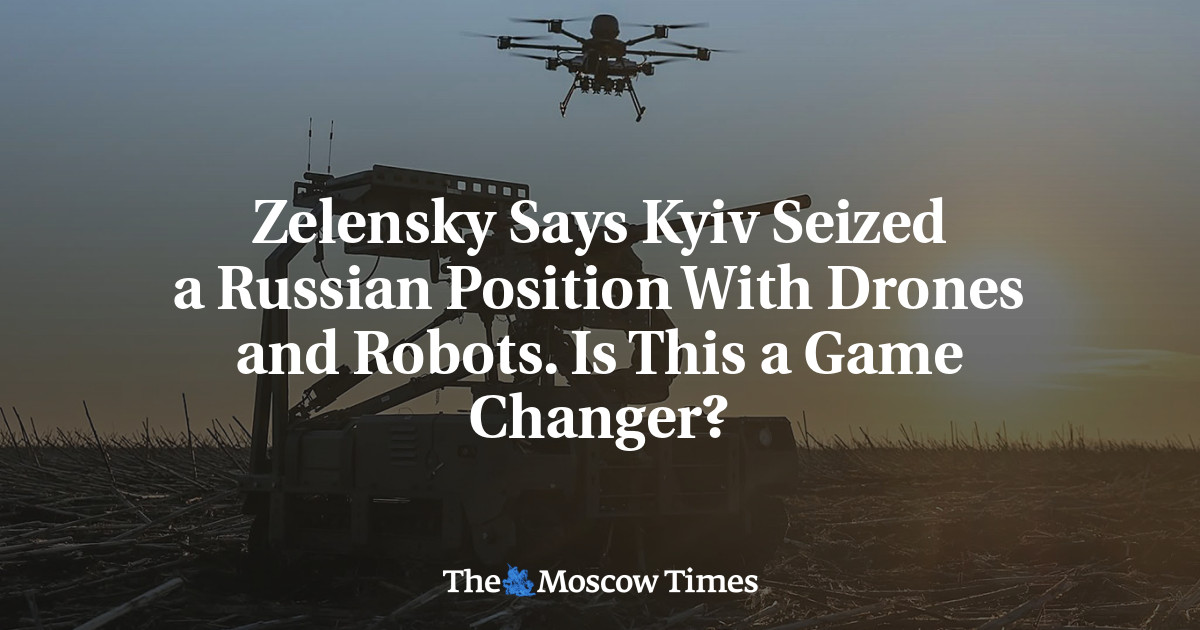
Ukraine said it captured a Russian position using only drones and unmanned ground vehicles for the first time, with Zelensky claiming the operation involved no infantry and no Ukrainian losses. He also said Ukraine’s long-range drones can strike targets up to 1,750 kilometers from the border and that ground robotic systems have completed more than 22,000 frontline missions in three months. The piece underscores rapid battlefield adoption of unmanned systems and its implications for the Russia-Ukraine war and defense technology.
The investable signal is not the headline stunt; it’s the confirmation that low-cost autonomy is moving from support function to offensive capability. That changes the production function of warfare: marginal battlefield gains increasingly depend on software iteration, sensor fusion, EW resilience, and manufacturing throughput rather than legacy platform count. The winners over a 6-18 month horizon are the companies that can supply drone frames, components, radios, edge AI, and counter-UAS layers at scale; the losers are slower-moving prime contractors whose value proposition is tied to expensive manned systems with long procurement cycles.
The second-order effect is a spending shift inside defense budgets, not necessarily an outright budget expansion. As unmanned systems prove they can substitute for personnel, ministries will reallocate toward autonomy, loitering munitions, EW, and battlefield networking, compressing timelines for procurement and favoring vendors with software-updatable products and dual-use manufacturing. In Europe, this should accelerate joint ventures and local-content deals, which benefit smaller drone manufacturers and niche electronics suppliers more than the headline primes.
The main risk to the thesis is political theater outrunning industrial reality. A single successful operation is evidence of capability diffusion, not yet of durable battlefield dominance; if EW counters, weather, or command-and-control failures expose fragility, the procurement premium in drone names can fade quickly. Over 3-9 months, watch for budget announcements, repeatable mission data, and evidence that Europe is writing larger framework contracts rather than pilots; those are the catalysts that convert narrative into revenue.
Contrarian view: the market may already be underestimating how disruptive this is for labor-intensive ground warfare and overestimating how quickly traditional armor/artillery advantages can be restored. But it may also be overpricing the near-term revenue uplift for defense suppliers, because many of these programs are still low-margin, small-ticket, and subject to fragmentation across vendors and jurisdictions. The cleaner trade is not "buy all defense"; it is to own the picks-and-shovels layer of autonomy while fading the parts of defense most exposed to manned-platform substitution.
AI-powered research, real-time alerts, and portfolio analytics for institutional investors.
Request TrialOverall Sentiment
neutral
Sentiment Score
0.15
