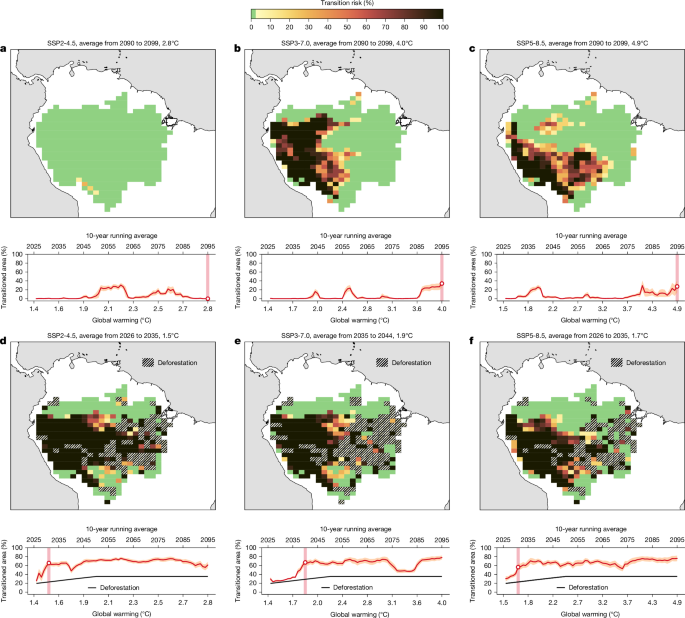
The study finds the Amazon faces a systemic transition risk at 3.7–4.0°C of global warming without deforestation, but that threshold falls to just 1.5–1.9°C when deforestation reaches 22–28%, with 62–77% of the basin at risk of degraded ecosystem shift. Cascading moisture-recycling feedbacks are identified as the main driver of collapse risk, implying heightened downside for climate-sensitive sectors and downwind agricultural regions in South America. The authors say keeping warming below 1.5°C, halting deforestation, and restoring forests are critical to avoid widespread Amazon destabilization.
The market is still pricing Amazon climate risk as a long-dated philanthropy issue, but the paper’s key implication is nearer-term regime risk for any asset with exposure to South American hydrology, agriculture, infrastructure, and sovereign risk. The non-obvious second-order effect is that the basin’s moisture recycling makes land conversion a self-reinforcing input shock, not just a biodiversity story: once local drying starts, the damage propagates downwind and can impair rainfall far beyond the deforested footprint. That raises the probability of correlated losses across multiple “unrelated” cash flow streams, which is exactly the kind of hidden correlation hedge funds underwrite poorly until it re-prices all at once.
The cleanest trade is not “buy climate winners / short climate losers” in the abstract, but to target businesses whose margins depend on stable rainfall and river transport in Brazil and adjacent export corridors. Agriculture, utilities, rail/logistics, and infrastructure names with exposure to the southern Amazon water cycle face a long-duration but nonlinear earnings risk: once threshold conditions are approached, the operating regime can shift faster than consensus models because the network effect accelerates the downside. By contrast, restoration, water infrastructure, and adaptation-capex beneficiaries may see a more immediate capital-allocation tailwind as governments and lenders shift from mitigation rhetoric to resilience spending.
Contrarian point: the consensus may overfocus on the global temperature number and underweight geography. The paper implies that location of deforestation matters as much as the aggregate percentage, because east-to-west propagation is what turns a bad local outcome into a basin-wide one. That means policy headlines about “stabilizing” total deforestation can still be insufficient if the remaining clearing concentrates in the wrong corridor; the investable risk is a spatially concentrated, not uniform, failure mode.
AI-powered research, real-time alerts, and portfolio analytics for institutional investors.
Request DemoOverall Sentiment
strongly negative
Sentiment Score
-0.78
