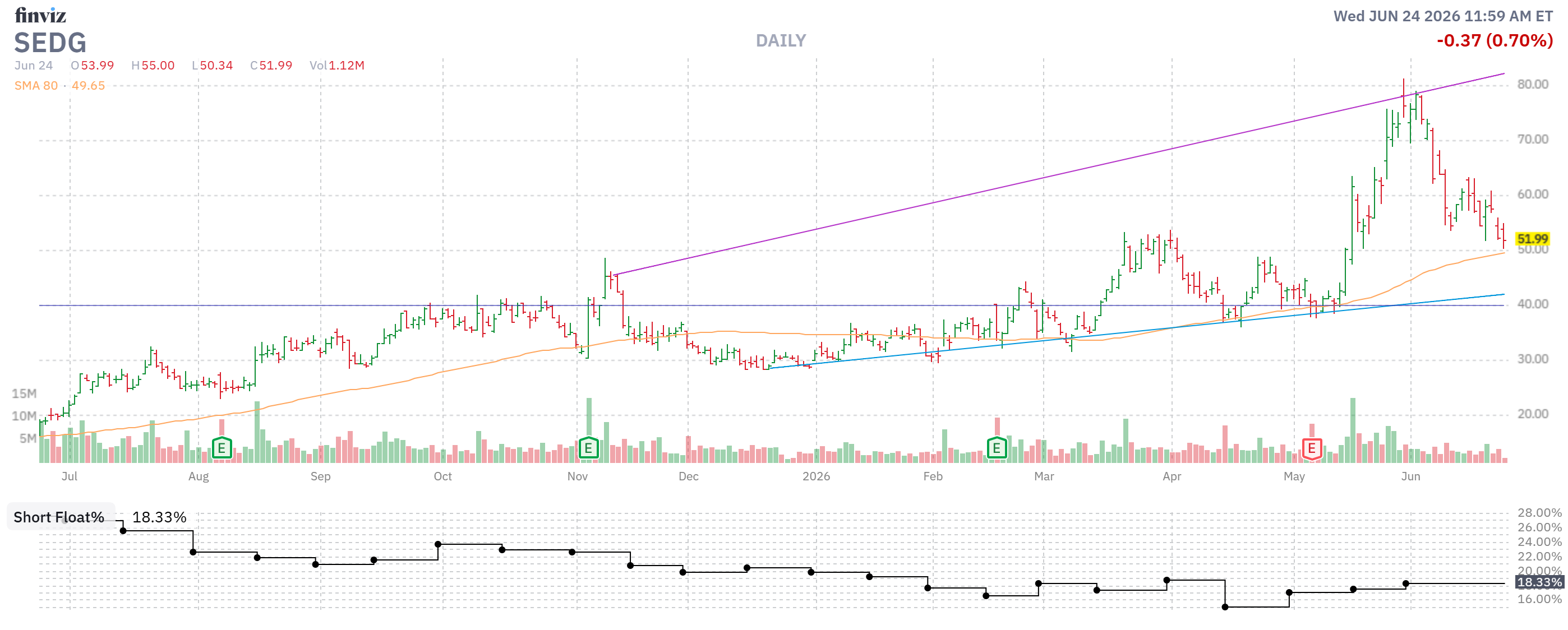
SolarEdge is down 32% in June and 36% off its May 29 two-year high, but the stock has historically rebounded after trading near its 80-day moving average under similar conditions. Short interest has risen 7.3% in the last two reporting periods to 10.95 million shares, or 18.2% of float, while analysts remain largely bearish with 25 of 26 brokers at hold or strong sell and a $40.87 consensus target, 20.6% below the current price. The article is mainly a contrarian technical and positioning note rather than a fundamental catalyst.
The setup looks more like a positioning reset than a pure fundamentals story. When a high-beta renewable name becomes crowded on the short side into a fast decline, the marginal seller can disappear quickly, and the first catalyst is often not a fundamental beat but a stabilization in tape and implied vol. With 18% of float short, any improvement in trend or a benign earnings/guide cadence can force fast covering over a 2-6 week window, especially if the stock reclaims a level that systematic trend followers use as a de-risk signal.
The consensus may be anchoring to old price targets and missing how quickly sentiment can re-rate in a secular growth cohort once a drawdown gets large enough. The more important second-order effect is that SolarEdge’s move is likely influencing the entire clean-tech basket: a sharp reversal here would mechanically squeeze relative-value shorts in inverter, ESS, and other solar hardware peers, while continued weakness would pressure channel inventory assumptions across the group. That makes the trade less about the company in isolation and more about whether the market is mispricing the duration of the de-rating.
The main risk is that this becomes a value trap if the stock’s rally over the past year was driven by multiple expansion rather than durable earnings revisions. In that case, the next leg lower would likely be a slower grind over 1-3 months as analyst downgrades and target cuts catch up, not an immediate collapse. The cleanest tell is whether the stock can hold its recent base on rising volume; failure there would argue the short interest is still aligned with momentum rather than crowded against it.
From a contrarian lens, the opportunity is that this is exactly the kind of dislocation where options can express convexity without committing full balance-sheet risk. The historical tendency to mean-revert after a deep pullback suggests the market may be overestimating how much bad news is already reflected, while underestimating the probability of a sharp technical snapback. The asymmetry is strongest if the stock can trade back above the short-term moving average and hold for several sessions, which would likely trigger systematic buying and squeeze optionality.
AI-powered research, real-time alerts, and portfolio analytics for institutional investors.
Request DemoOverall Sentiment
neutral
Sentiment Score
0.15
Ticker Sentiment
