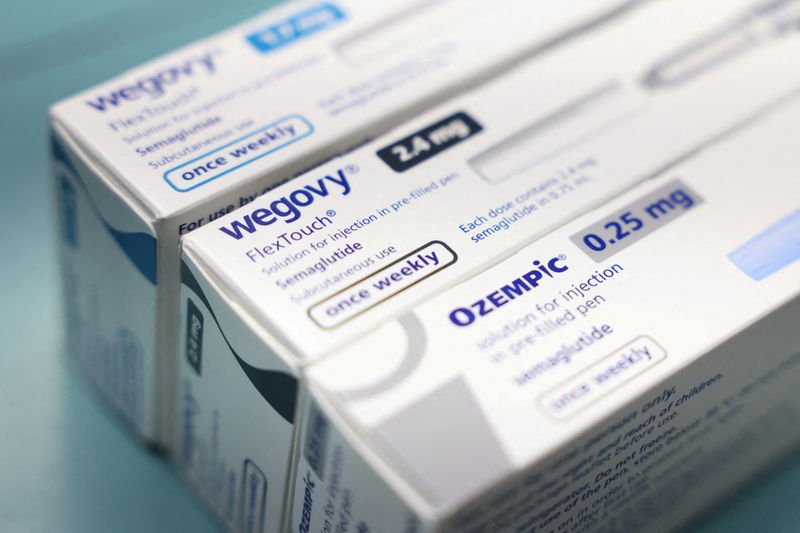
Novo Nordisk raised its 2026 outlook, now expecting adjusted sales and operating profit to decline 4% to 12% at constant exchange rates, narrower than before on stronger GLP-1 demand. Q1 results were mixed: operating profit rose 65% to 59.6 billion Danish crowns on a one-off 340B reversal, but adjusted operating profit fell 6% to 32.9 billion crowns and adjusted sales slipped 4% to 70.1 billion crowns. Obesity treatment sales rose 22% at constant exchange rates, helped by Wegovy, including its new U.S. pill version, which generated 2.3 billion crowns in quarterly sales.
The key takeaway is that the quarter validates a stronger demand curve for GLP-1s, but the stock’s near-term driver is not volume growth — it is the market’s willingness to look through a prolonged margin reset. The mix is deteriorating in a way that can persist for several quarters: higher unit demand is being monetized at lower realized prices, so earnings power is increasingly hostage to payer negotiations and channel mix rather than pure prescription growth.
Second-order, the beneficiaries are likely to be the downstream access-enablers rather than the originator alone. Better affordability broadens patient penetration, which should help compounding pharmacies, telehealth distribution, and insurers that can steer members into lower-cost care pathways; the flip side is intensified pressure on rival obesity franchises that need both differentiation and pricing power to keep economics intact. In that sense, the “winner” is the category, but the incremental profit pools migrate away from premium branded pricing toward scale, access, and utilization management.
The main risk is that the market extrapolates a clean reacceleration while the next 1-2 quarters still contain price-led gross margin drag. If reimbursement tightens again, or if competition forces another leg down in net pricing, consensus growth estimates will remain too high even as headline volume looks healthy. Patent-expiry anxiety also matters more for valuation than for current earnings, because it raises the terminal multiple discount rate before it shows up in the P&L.
The contrarian angle is that the stock may already be pricing the easy part of GLP-1 adoption, while underpricing how much of the upside gets recycled into access spending, rebates, and capacity expansion. That argues for being selective on the equity beta and more tactical on option structures: the duration of the story is long, but the path to monetization is uneven and likely choppy over the next 3-6 months.
AI-powered research, real-time alerts, and portfolio analytics for institutional investors.
Request DemoOverall Sentiment
mildly positive
Sentiment Score
0.35
Ticker Sentiment
