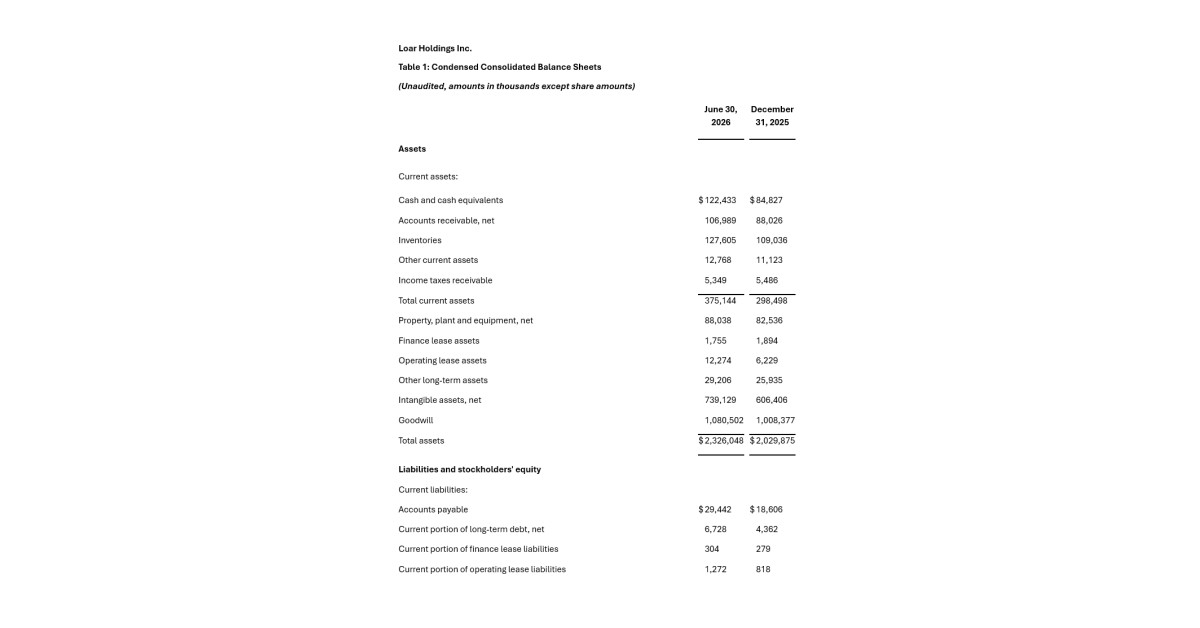
Loar Holdings reported Q2 2026 net sales of $171.6M (+39.4% YoY) and Adjusted EBITDA of $69.4M (+47.4% YoY) alongside an Adjusted EPS of $0.38 (+22.6% YoY). Net income was $16.7M (flat YoY), with net income margin declining to 9.8% from 13.6% due to higher interest expense and non-cash amortization. The company revised its full-year 2026 outlook upward: net sales to $665M–$675M (vs. $645M–$655M prior), Adjusted EBITDA to $265M–$270M (vs. $257M–$262M), and Adjusted EPS to $1.32–$1.36 (vs. $1.26–$1.30), while maintaining ~40% Adjusted EBITDA margin.
LOAR is behaving like a high-quality aerospace roll-up, but the market should focus less on reported EPS and more on the compounding path of EBITDA into equity value. The combination of >40% EBITDA margins and double-digit organic growth argues for multiple support, yet the balance sheet keeps this from being a pure quality story: every incremental dollar of operating improvement is disproportionately valuable only if management keeps delevering faster than it acquires. That makes the stock more sensitive than peers to any sign that acquisition cadence slows or financing costs stay sticky.
Second-order, the strongest read-through is to the niche aerospace supplier complex rather than primes: names with similar aftermarket exposure and disciplined M&A may benefit from valuation sympathy, while weaker levered suppliers could lag if investors rotate toward self-funded compounders. The pipeline visibility is useful, but not all “booked” revenue is equal; the real catalyst is conversion into sustained organic demand, because that is what can de-risk the credit story and justify a higher long-duration multiple. If the growth is mostly inorganic, the equity should not get full-credit for margin expansion.
The contrarian angle is that consensus may be underestimating how much of the upside is already in the levered balance-sheet math. If interest expense remains roughly flat, small EBITDA beats can still fail to translate into meaningful net-income upside, which caps near-term re-rating. Falsifiers: organic growth slipping below high-single digits, EBITDA margin dropping under 39%, or any slowdown in aftermarket momentum over the next 1-2 quarters.
AI-powered research, real-time alerts, and portfolio analytics for institutional investors.
Overall Sentiment
strongly positive
Sentiment Score
0.60
Ticker Sentiment
