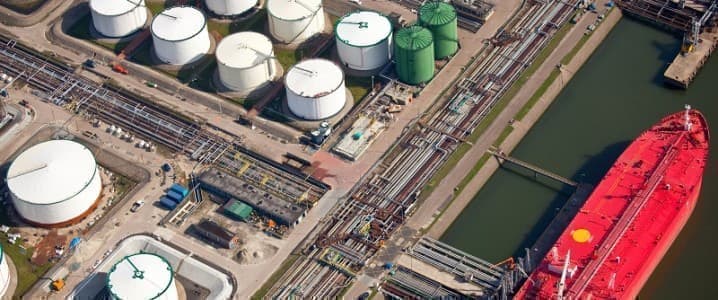
March 9: debris from an intercepted drone sparked a fire in the Fujairah Oil Industry Zone, forcing bunker terminals to suspend barge loadings and preventing stock replenishment at one of the world's largest marine fuel hubs. Traders report reduced offers and bunker prices pushed sharply higher, with suppliers running on floating inventories and some shipping operators implementing emergency fuel surcharges. The incident is amplifying a Gulf-wide energy shock—Strait of Hormuz traffic has slowed and producers including Saudi Arabia, Iraq, Kuwait and the UAE have cut output amid recent facility outages (e.g., Ras Tanura, Qatar LNG). Expect upward pressure on marine fuel and crude prices, tighter bunker availability, and increased volatility across shipping costs and regional energy flows.
A disruption concentrated at a single strategic bunkering node amplifies price sensitivity across maritime fuel and freight markets because on-water inventories and short-haul barge replenishment are the marginal source of supply. Expect immediate micro-arbitrage: ships extend on-board fuel inventories and delay port calls, which raises demand for large-tanker bunkering and lifts spot dirty tanker earnings; a plausible first-order move is a 30–70% spike in spot clean/dirty product freight differentials within 1–3 weeks as rebalance occurs.
Second-order effects flow into contract structures and supply chains: liner and bulk carriers that operate on fixed-rate, longer-term contracts will absorb higher fuel costs for multiple quarters before surcharges fully pass through, compressing EBITDA margins by mid-teens percentage points for highly fuel-intensive routes over 1–3 months. Refiners and blend-capable facilities that can supply high-sulphur fuel oil or adapt blending yields will capture outsized margins in the near term; this is a capacity and logistics story more than a crude price shock initially.
Catalysts that would reverse the dislocation are operational (rapid repair and throughput recovery at the affected node within 2–6 weeks) or political (de-escalation and guaranteed safe-transit corridors). Tail risks skew to the downside for supply if outages cascade or if chokepoint congestion forces longer detours through higher-risk waters — under that scenario energy product spreads could remain elevated for 3–9 months, prompting inventory hoarding and cross-regional rerouting.
Liquidity and derivative implications: expect forward curves for marine fuels to flatten or go into stronger backwardation as near-term scarcity replaces contango-driven storage plays. That favors cash-and-carry arbitrage unwinding and benefits asset owners of on-water storage and tankers while penalizing short-cycle consumers and fixed-rate freight operators until normalised flows resume.
AI-powered research, real-time alerts, and portfolio analytics for institutional investors.
Request DemoOverall Sentiment
strongly negative
Sentiment Score
-0.65
