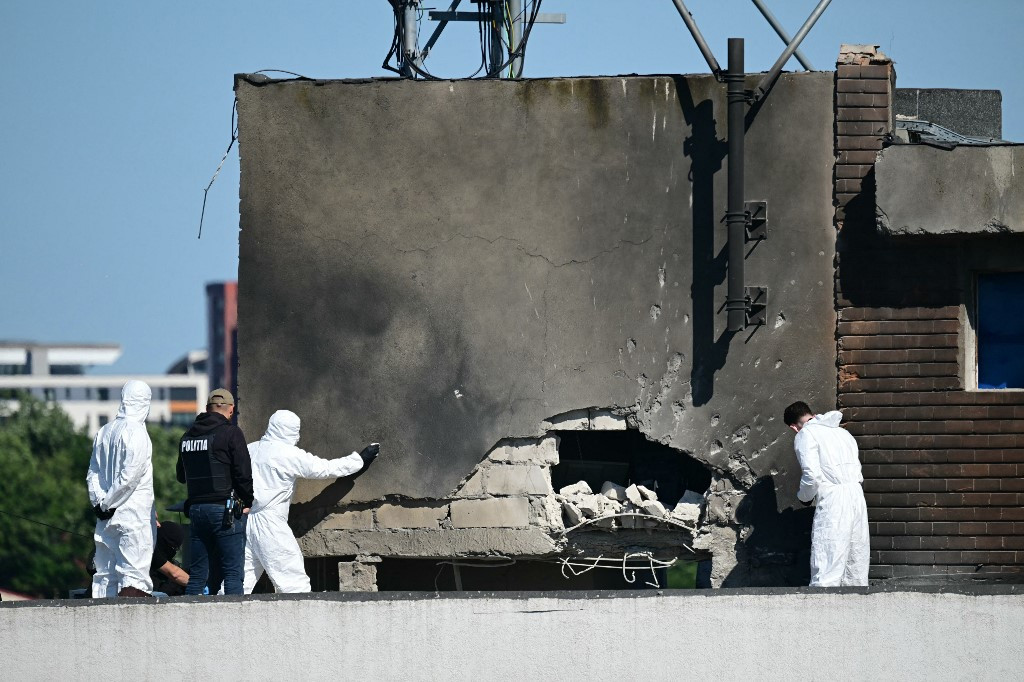
A Russian drone crossed into Romanian airspace and struck a residential building in Galați, injuring 2 people and prompting Romania to expel Russia’s consul general and close its consulate in Constanța. Romanian officials said they tracked the drone but could not intercept it in time, highlighting legal and operational constraints on NATO air defenses near the Ukrainian border. The incident increases regional escalation risk, though the immediate market impact is likely concentrated in European defense and geopolitical risk sentiment rather than broad markets.
This is not an escalation headline so much as a deterioration in the credibility of the European air-defense perimeter. The second-order issue is that once a NATO state is repeatedly forced to tolerate drone overflight without reliable intercepts, the market starts pricing a higher probability of accidental cross-border damage, retaliation signaling, and a broader rules-of-engagement debate inside the alliance. That favors firms tied to air defense, ISR, counter-UAS, and border surveillance, while raising the political cost of any “Ukraine fatigue” narrative because the spillover risk is now visibly domestic for Romania and potentially other Black Sea states.
The most important near-term catalyst is legal/operational, not military: if Romania and peers widen engagement authority, procurement urgency for short-range air defense and drone-kill chains should accelerate over the next 1-3 quarters. This is structurally bullish for European defense primes and for lower-tier suppliers exposed to radars, EW, effectors, and perimeter protection, because the bottleneck is no longer only budgets but deployable, legally actionable systems around civilian infrastructure. The flip side is that any successful diplomatic de-confliction or improved Ukrainian electronic warfare that reduces drone leakage would cool the urgency quickly.
The contrarian point is that markets may underappreciate how limited the immediate military implication is for Russia: cheap drones remain a low-cost harassment tool, and intermittent border incidents are more likely to raise defense capex than alter the war’s trajectory. The real macro trade is not “higher oil” but “higher European defense spend persistence,” with the strongest convexity in names that benefit from multi-year replenishment cycles rather than one-off emergency purchases. If this becomes a template across the eastern flank, the valuation rerating in air-defense suppliers could persist well beyond the next headline cycle.
AI-powered research, real-time alerts, and portfolio analytics for institutional investors.
Request TrialOverall Sentiment
mildly negative
Sentiment Score
-0.35
