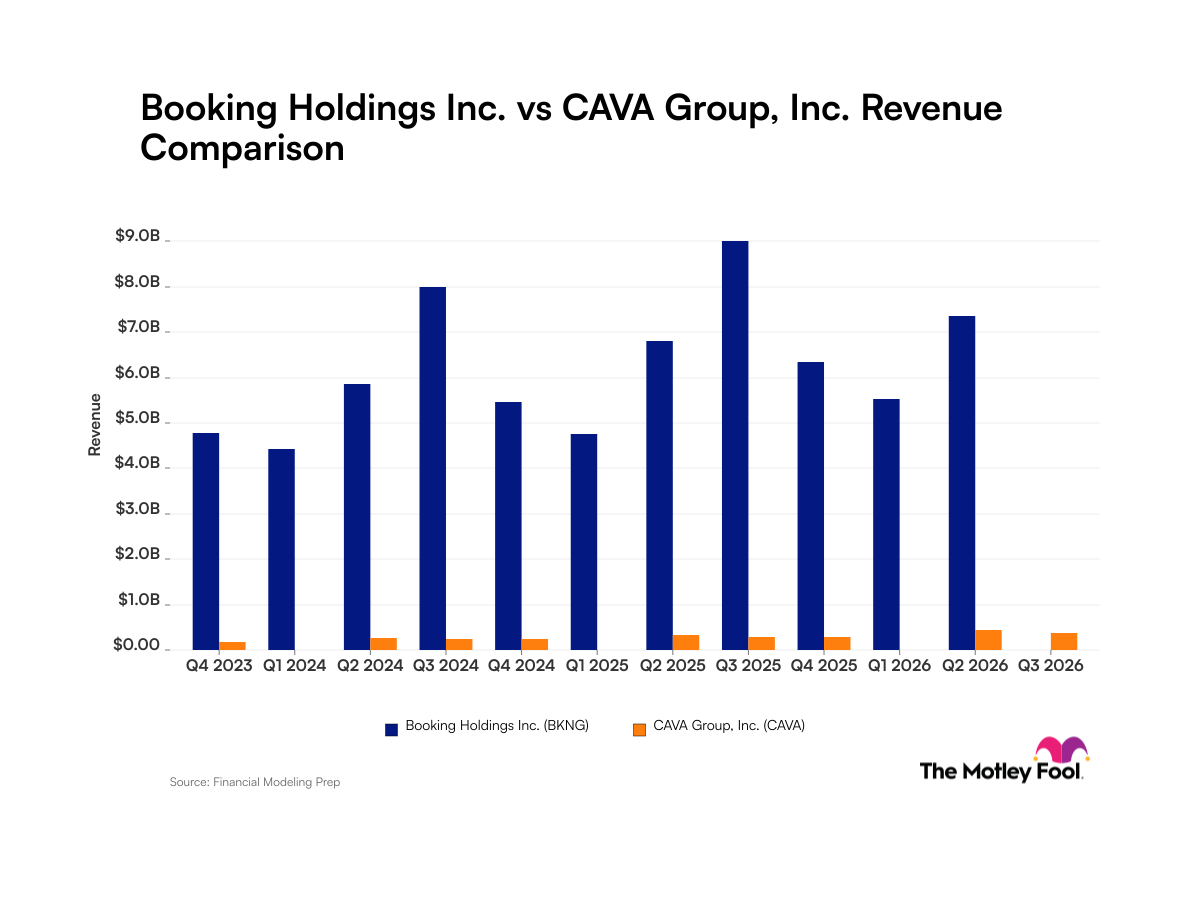
Booking (BKNG) and CAVA (CAVA) show steady top-line performance despite seasonal quarterly revenue swings, with shares up 2.28% and 4.88%, respectively. BKNG posted ~34% operating margin for the quarter ended June 30, 2026, while CAVA generated ~8% free-cash-flow margin for the quarter ended July 12, 2026. On a trailing-12-month basis, BKNG revenue rose 13% Y/Y to ~$28B and CAVA revenue grew 27% Y/Y to ~$1.4B; risks include an expanded European hospitality lawsuit for BKNG and early-stage CAVA restaurant scaling.
BKNG is still the cleaner quality compounder: the market should care more about the durability of its margin structure than the quarter-to-quarter revenue cadence. A mid-30s operating margin in a heavily competitive travel stack implies strong pricing/take-rate power and enough cost flexibility to absorb legal or restructuring noise without a near-term earnings reset. The bigger risk is not demand, but a slow leak in economics if European regulation forces lower commissions or tighter price-parity mechanics; that would likely show up first in multiple compression before it shows up in reported revenue.
For CAVA, the important signal is that growth is still being funded by a business model that has not yet fully proven scale efficiency. An 8% free-cash-flow margin is decent for an expansion story, but it leaves less cushion if labor, food, or occupancy inflation re-accelerates; the internal career platform is a hint that management is trying to reduce future hiring friction and turnover, which could matter more to unit economics than to headline sales. The contrarian risk is that the equity may be pricing a long runway of premium unit growth while the real constraint is labor density and new-store saturation, not demand.
Relative winners here are BKNG over lower-quality travel intermediaries and CAVA only if the market keeps rewarding growth over cash flow. Second-order, any BKNG weakness from litigation could be a read-through to EXPE and ABNB multiple risk, while CAVA’s valuation is more vulnerable to a rates-up / discretionary-spending-down regime because its duration is longer and its cash generation is still shallow. The consensus may be underestimating how little revenue volatility matters for BKNG versus how much execution consistency matters for CAVA.
AI-powered research, real-time alerts, and portfolio analytics for institutional investors.
Request DemoOverall Sentiment
mildly positive
Sentiment Score
0.22
Ticker Sentiment
