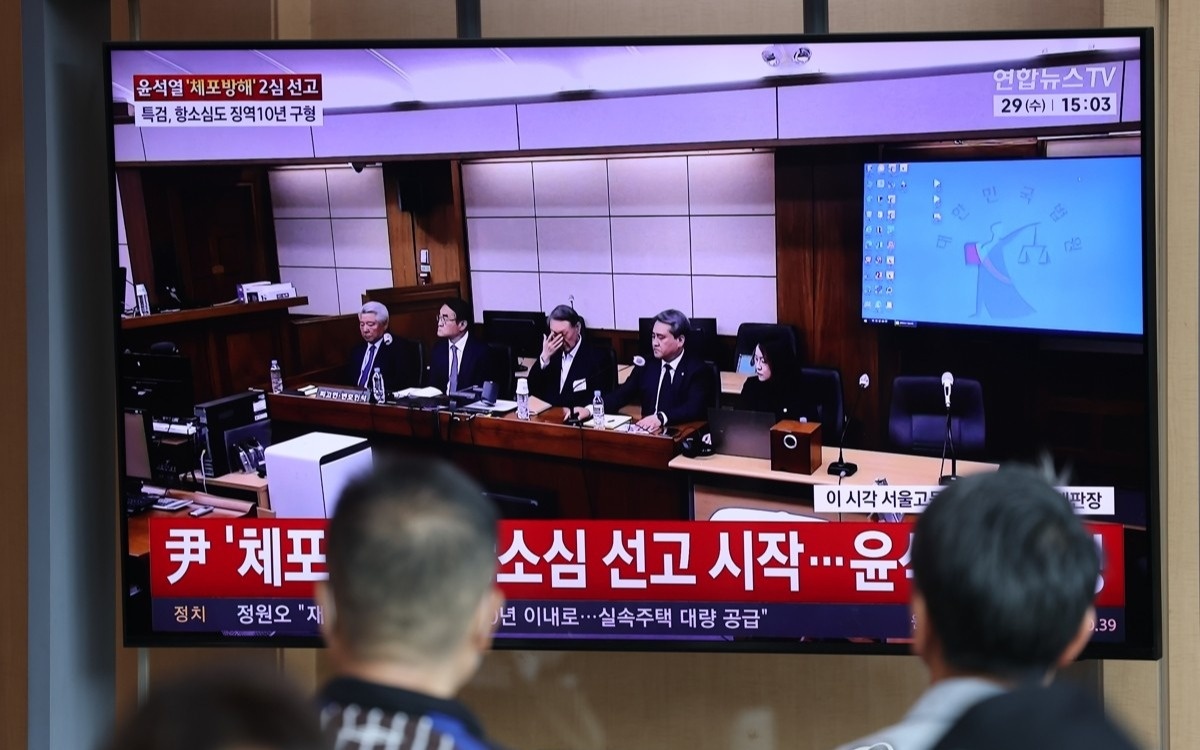
South Korea's appeals court raised former President Yoon Suk Yeol's sentence to 7 years from 5 years in prison over obstruction of justice and related charges tied to his failed martial law bid. The ruling, delivered live by the Seoul High Court, reflects escalating legal jeopardy for the ousted leader after special counsel prosecutors had sought a 10-year term. The case is politically significant but likely has limited direct market impact.
This is less a market event than a governance overhang reduction for South Korea: the judiciary is signaling that executive overreach has real personal cost, which modestly improves institutional credibility over the medium term. That matters for capital allocation because Korea’s discount has historically embedded a political-risk premium around policy continuity, conglomerate regulation, and enforcement unpredictability. A harsher penalty also reduces the odds of a quick rehabilitation narrative for Yoon-linked factions, keeping headline risk elevated into the next election cycle.
The immediate winner is not a single sector but the broader anti-risk trade in Korea: domestic cyclicals, banks, and telecoms typically benefit when policy uncertainty falls and the market shifts from “who is in power” to “what reforms survive.” The most vulnerable names are those with direct exposure to politically sensitive procurement, defense-adjacent contracts, and firms that had been pricing in a more business-friendly turn under a Yoon restoration scenario. Second-order, the ruling may also strengthen enforcement momentum around governance and related-party practices, which is negative for low-transparency chaebols but positive for quality large caps with clean capital return stories.
Near term, the risk is not equity beta but event-driven volatility: courtroom developments can whipsaw sentiment over days, while any political retaliation or constitutional ambiguity can keep the KOSPI discount sticky for months. If the case catalyzes broader crackdowns or protest dynamics, domestic consumption and won stability could weaken before fundamentals do. Conversely, if the opposition overreaches and pushes a credibility-damaging purge narrative, the market could quickly fade the initial institutional-positive read.
The consensus is likely underestimating how little direct macro impact this has unless it spills into budget, trade, or labor policy. The more important angle is that Korea may get a cleaner governance premium re-rating if the legal system is seen as independent; that can matter more for multiples than the identity of any one politician. The move looks underdone for governance-heavy foreign inflows, but overdone if investors assume an immediate policy regime change.
AI-powered research, real-time alerts, and portfolio analytics for institutional investors.
Request DemoOverall Sentiment
mildly negative
Sentiment Score
-0.20
