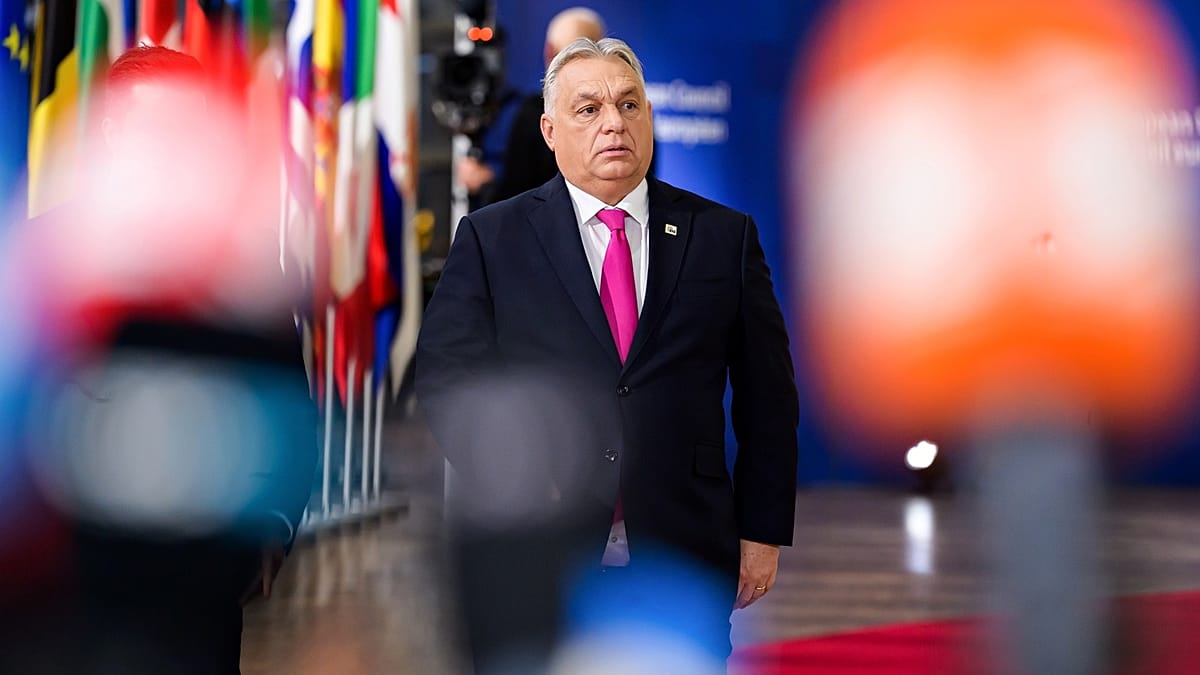
The EU is scrambling to lift Hungary's veto on a €90 billion loan to Ukraine after Prime Minister Viktor Orbán blocked the package over a dispute tied to disruption of the Druzhba oil pipeline; Brussels is pursuing options including a Ukrainian repair, a fact‑finding mission, rerouting Russian crude via Croatia’s Adria/JANAF (Croatia says it is not obliged), and legal workarounds (Articles 48.7, 4.3 and 327 were discussed). The impasse risks delaying crucial funding ahead of an early‑April cash crunch for Ukraine and has political overtones ahead of Hungary’s 12 April election, while the EU’s SAFE defence facility (€150 billion total; Hungary’s national SAFE plan = €16.2 billion) has been pulled into the dispute as a leverage point.
Market structure: The immediate winners are Hungary’s energy incumbents (MOL) and Croatian transport interests (JANAF/Croatian exporters) if Adria becomes the main route; losers are Ukrainian pipeline operators, regional refiners exposed to Druzhba flows, and EU political cohesion. Expect 1–3 months of supply re-routing costs as Hungary/Slovakia require ~10.4 Mtpa combined (Hungary 5.75 Mt, Slovakia 4.66 Mt), lifting local crude premiums by a few $/bbl and refinery feedstock logistics margins. Energy pricing power shifts to seaborne/Adriatic capacity and tanker arbitrageurs; Russian Urals seaborne flows will reprice relative to Urals-on-Druzhba baselines.
Risk assessment: Tail risks include (1) protracted veto leading to suspension of the €90bn tranche by early April and Ukraine cutting public services, (2) kinetic escalation that prevents Druzhba repairs, and (3) legal precedent forcing EU Treaty mechanisms — each could widen CEE sovereign spreads by 50–200bp. Immediate (days) volatility will center on HUF and MOL stock; short term (weeks) on 5y Hungary CDS and Brent-Urals spreads; long term (quarters) on SAFE approvals and cross-border legal rulings. Hidden dependency: Orbán’s electoral calendar (12 Apr) is the fulcrum—policy moves will cluster ±2 weeks around that date.
Trade implications: Favor selective oil/logistics plays and political-risk hedges: capture Brent-Urals dislocations (3-months) and long MOL equity exposure while hedging Hungary sovereign risk via CDS or short local bonds. Use FX to express divergence: long CZK vs HUF or short EUR/HUF with 1–3 month tenors; defense contractors could get a cyclical uplift if SAFE plans are approved (window 30–90 days). Entry should be staged: 50% pre-election, 50% conditional on vote/outcome and Commission legal signals.
Contrarian angles: Consensus overweight on energy disruption misses the legal path (Article 327/4.3) risk that could force an administrative workaround — if Brussels weaponizes treaty clauses, Orbán may fold and disruption will be short lived, compressing premiums by >$2–3/bbl within 4–6 weeks. Conversely, markets underprice political theater: if SAFE approval is delayed and Orbán frames it as victory, Hungarian assets could jump 5–10% intraday; this creates mean-reversion pair trades. Historical parallel: 2014 Crimea-era sanctions saw transient regional FX dislocations that reverted over 2–3 months once alternate logistics scaled.
AI-powered research, real-time alerts, and portfolio analytics for institutional investors.
Request DemoOverall Sentiment
moderately negative
Sentiment Score
-0.35
