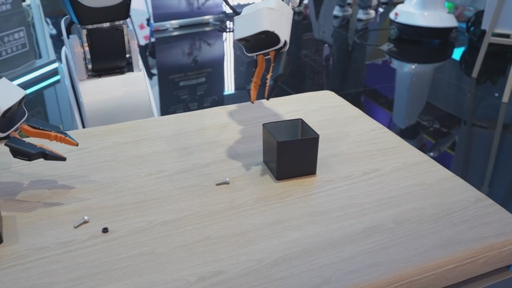
TARS debuted at WAIC 2026 as its AWE embodied foundation model won the SAIL (Superior Al Leader) Award for technical innovation and industrial potential. CEO Dr. Chen Yilun introduced AWE 3.5, claiming it approximately doubles task-execution efficiency vs Pi 0.5 while maintaining closed-loop performance for multi-minute tasks. The company also plans to expand its pre-training dataset from 1 million to 10 million hours by end-2026, and showcased industrial and robotics demos including an automotive wiring-harness production line and the DexHand performer robot.
Near term, this reads more like a sentiment event than a fundamental re-rate: the market may give TARS a short-lived “AI robotics” multiple lift, but the real question is whether the company can convert demo quality into contracted throughput with acceptable uptime and service economics. In embodied AI, the moat is not model architecture alone; it is dataset advantage + deployment cadence + field reliability, so any valuation support should be tied to order intake, repeat deployments, and gross margin on installed systems rather than awards or showcase wins.
The second-order winners are the picks-and-shovels around industrial robotics: machine vision, force/tactile sensors, precision actuators, and systems integrators that can absorb model improvements without needing proprietary data themselves. The likely losers are labor-heavy line processes and commoditized automation vendors if TARS’ stack proves it can reduce cycle time enough to justify replacement capex. But if the economics are real, the first beneficiaries are actually the customers: wiring-harness, electronics, and light assembly plants where labor scarcity and defect costs make payback periods most visible.
Contrarian view: the market may be underestimating how difficult “generalization” is in factory conditions, where edge cases are endless and customers demand deterministic uptime. A 10M-hour dataset target is impressive operationally, but it can also signal that the model is still data-hungry and expensive to scale; if so, margin expansion could lag hype by 12-18 months. The catalyst path to watch is 1-3 months: named pilot conversions, disclosed backlog, and evidence that deployments move beyond subsidized demos. If those don’t show up, the thesis reverts to a PR-driven trade and the stock should fade on the next financing or earnings update.
AI-powered research, real-time alerts, and portfolio analytics for institutional investors.
Request DemoOverall Sentiment
mildly positive
Sentiment Score
0.25
Ticker Sentiment
