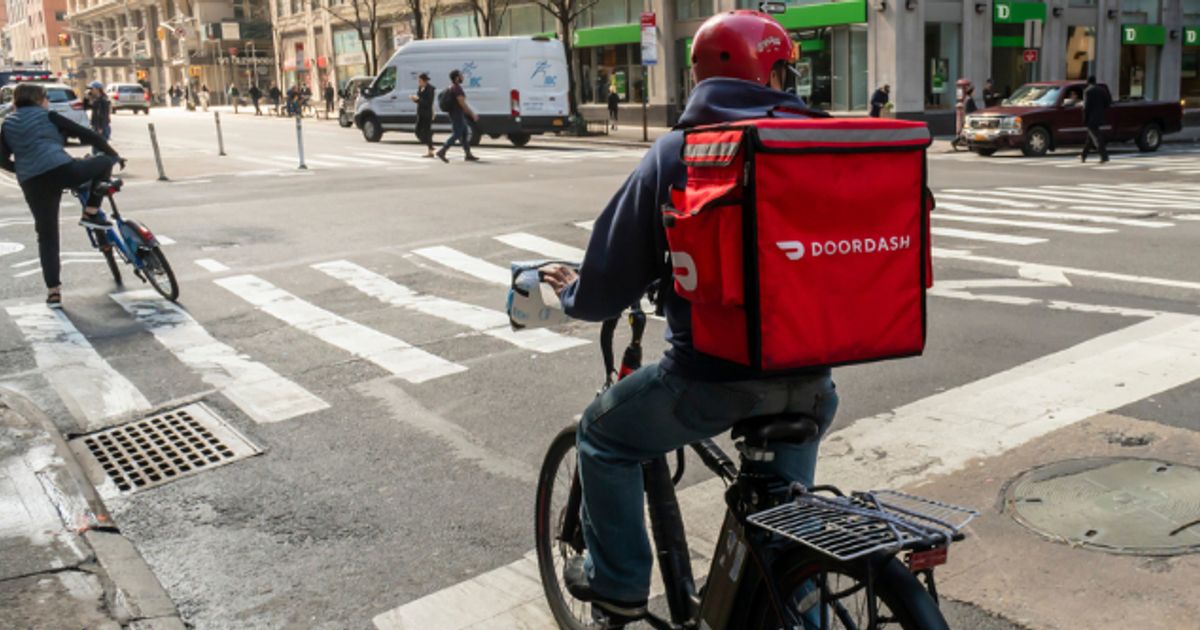
Bank of America expects DoorDash Q4 gross order value of $29.2bn, revenue of $3.94bn and EBITDA of $792m (Street: $29.2bn, $3.99bn, $774m), citing healthy online shift and strong retail delivery offsetting softer restaurants; US online restaurant spending was up 8% YoY in Q4. BofA cuts Q1 EBITDA to $759m (Street $804m) due to higher early-2026 investments and potential weather impacts but leaves 2026 full-year EBITDA at $3.6bn (including $200m from Deliveroo); the firm maintained a Buy rating while trimming its price target to $260 from $305. Shares trade at $163, down ~28% YTD, with BofA noting limited AI risk and arguing recent sector selling may be overdone.
Market structure: DoorDash benefits directly from a durable online/retail delivery shift (BofA GOV $29.2bn Q4 baseline) and its subscription/courier network preserves pricing power versus smaller aggregators; restaurants and pure dine-in exposure are the losers if consumers shift further to delivery. Competitive dynamics favor DoorDash capturing share in retail delivery where GMV is growing faster than restaurants, supporting steady core margins (~3.25% on GOV) but making margins sensitive to front‑loaded investments. Cross-asset: expect near-term equity volatility around Feb 18, modest credit tail-risk decline (EBITDA guidance still positive), and marginal FX sensitivity from the $200m Deliveroo contribution; energy/fuel spikes remain a direct cost pass-through risk for unit economics.
Risk assessment: Tail risks include a UK/US regulatory shock on gig classification, a failure/mark‑to‑market on Deliveroo stake (>‑$200m downside), or a macro GOV contraction (>5% q/q) that would compress EBITDA below BofA’s reduced Q1 $759m. Near term (days) the Feb 18 print and Q1 guide are biggest drivers; short term (weeks–months) execution on retail momentum and investment cadence matters; long term (2026–27) secular online share gains should sustain margin expansion if GOV growth >5% CAGR. Hidden dependencies: $200m Deliveroo credit, fuel and local wage pressure, and Uber’s retail cadence acting as a leading indicator. Catalysts: DoorDash Q4 (Feb 18), Uber results, UK Deliveroo liquidity events, and fuel CPI moves.
Trade implications: If you believe the selloff is overdone, establish a modest long in DASH sized to 2–5% of equity risk budget with tight stops; use call spreads to express upside without paying high IV into earnings. If you are cautious, buy short-dated protective put spreads around earnings or sell volatility after a constructive print. Consider pair trades where DoorDash’s retail exposure outperforms mobility-heavy peers (long DASH vs short UBER) over a 3–6 month window if Q1 guide holds. Timing: act pre-earnings only if you size for binary risk (use spreads); re-assess within 3 trading days post-release.
Contrarian angles: Consensus underweights Deliveroo’s conservative non‑US valuation (BofA uses 0.7x GOV) and may be overpaying for margin angst; the 28% YTD drop discounts long‑term GOV growth and a $3.6bn 2026 EBITDA base. The market may be overreacting to a front‑loaded investment narrative; historically (post-2019 delivery cycle) temporary margin pushes reversed as scale reasserted pricing power. Unintended consequences: if DoorDash levers Deliveroo gains into M&A or accelerates incentives to regain share, short-term margin pain could persist and punish illiquid option sellers.
AI-powered research, real-time alerts, and portfolio analytics for institutional investors.
Request DemoOverall Sentiment
mixed
Sentiment Score
0.08
Ticker Sentiment
