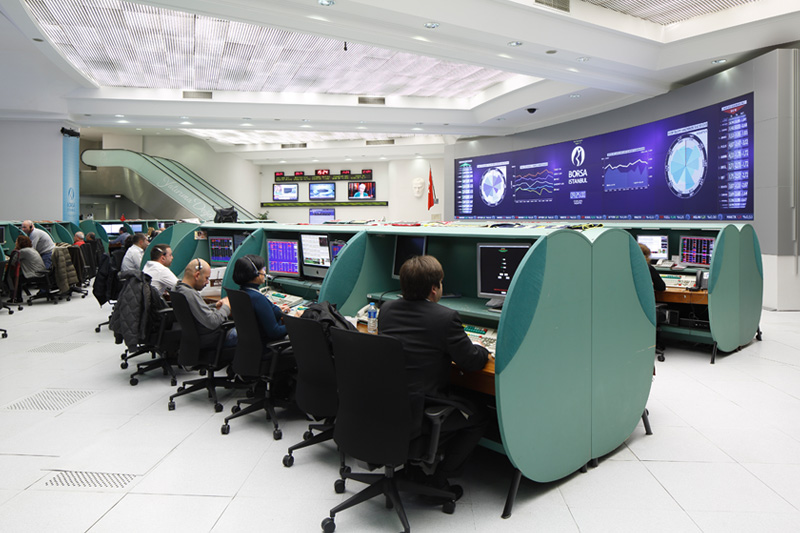
Turkey’s BIST 100 fell 0.26% to close lower, led by declines in Banking, Information Technology and Financials. Despite equities softness, gold futures for August rose 1.31% (+$53.96) to $4,179.66/oz as soft US jobs data cooled rate-hike expectations, while crude oil (Aug) slipped 0.31% to $68.48/bbl and Brent eased 0.04% to $71.77/bbl. USD/TRY inched up 0.18% to 46.80, indicating mildly firming FX risk sentiment.
The market is trading the data as a real-yield story, not a pure dollar story. That matters because the cleanest beneficiary is gold-linked duration: GLD and, with more convexity, GDX/royalty names if the soft labor print keeps terminal-rate expectations drifting lower. The second-order loser set is anything financed on cheap duration or sensitive to domestic funding stress — Turkish banks and REITs tend to get hit harder than the index when USD/TRY leaks higher because equity holders quickly demand a wider local risk premium.
The more interesting signal is the combination of firmer gold and softer crude: that usually reflects slower-growth pricing, which is bad for bank asset quality and loan demand before it is bad for headline GDP. In Turkey, a weaker lira can create a negative feedback loop where imported inflation keeps policy tight, margins compress, and financials lose both earnings and multiple support. That makes the banking weakness more durable than the small move in oil suggests.
Contrarian view: this is not yet a thesis on a new gold supercycle. If the next CPI or Fed commentary re-widens rate-hike/cut odds, gold can retrace sharply because positioning has become crowded on every softer-data print. For TGT specifically, there is no direct read-through worth paying for; the right move is to wait for confirmation in US real yields rather than force a retail trade off a macro headline.
AI-powered research, real-time alerts, and portfolio analytics for institutional investors.
Overall Sentiment
mixed
Sentiment Score
0.05
Ticker Sentiment
