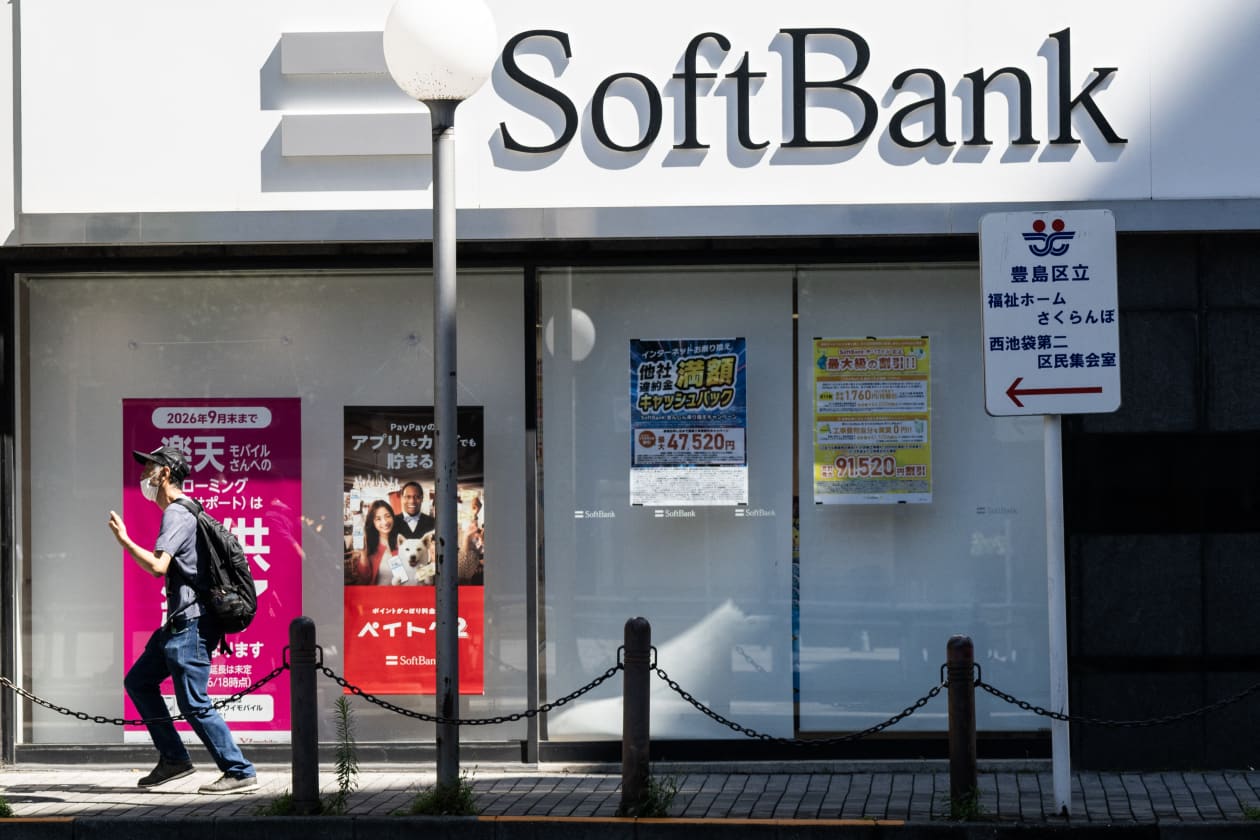
SoftBank reported Q2 net income of ¥347B (≈$2.19B) for April–June, well above LSEG analyst estimates of ¥147–166B, though it was still down 18% YoY. The article notes SoftBank’s NAV nearly doubled in Q2, but July volatility and uncertainty over the timing of OpenAI’s public listing limited the valuation uplift from its stake.
SoftBank is trading less like a conglomerate and more like a levered liquidation vehicle on AI risk appetite. The key market mechanism is not the earnings beat itself, but whether the market is willing to pay for illiquid private marks when the nearest monetization catalyst is still absent. If the OpenAI re-rating stays frozen, the equity will continue to trade off the volatility of its listed AI exposures and whatever discount investors demand for mark-to-model assets.
The immediate winner is the listed semiconductor complex that underpins the portfolio beta; those names have cleaner cash-flow visibility and can absorb AI capex without needing an IPO to crystallize value. The loser is any investor thesis that relies on SoftBank's NAV expanding mechanically: once the private-asset re-mark stalls, incremental upside has to come from public-market appreciation, which is a tougher bar in a choppy tape. That makes the stock more sensitive to Nasdaq/SMH direction over the next 1-3 months than to company-specific fundamentals.
The contrarian miss is that strong reported income can be a trap if it is driven by mark-to-market and not realizable cash. If July-style volatility continues, NAV can retrace quickly and the market may reapply a wider holding-company discount even after a good quarter. Falsifiers are straightforward: a concrete OpenAI listing timetable, another large private valuation step-up, or a sustained rally in AI semis that tightens the discount despite no monetization event.
AI-powered research, real-time alerts, and portfolio analytics for institutional investors.
Overall Sentiment
mildly positive
Sentiment Score
0.25
Ticker Sentiment
