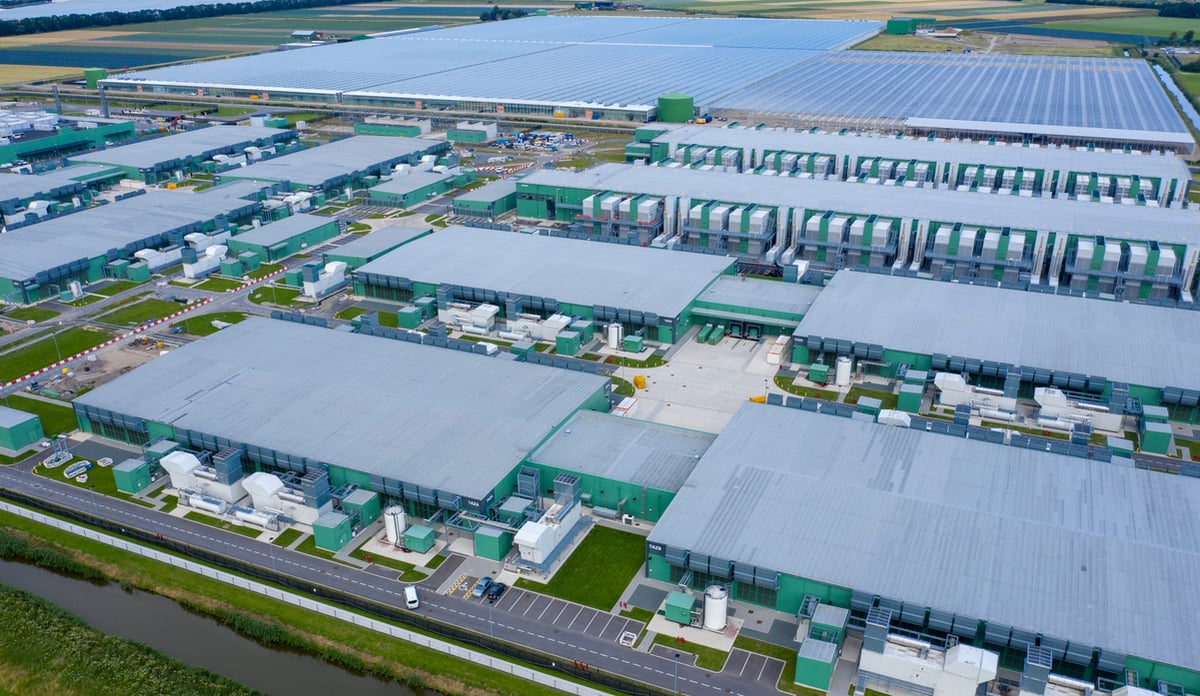
Applied Digital (APLD) shares have rallied ~265% YTD as the company positions its Polaris Forge campuses to supply hyperscalers amid a projected U.S. AI data-center power shortfall; it has a 15-year, $7 billion deal with CoreWeave for 400 MW at Polaris Forge 1. Polaris Forge 2 is planned for 300 MW (expandable to 1 GW), management is targeting $1 billion of net operating income over the next five years, and the company trades at an ~$8 billion market cap—implying meaningful upside if buildouts and commercial deals execute on schedule.
Market structure: Power-constrained AI capacity converts into a differentiated scarce asset — winners are Applied Digital (APLD), hyperscalers that lock long-term powered capacity (e.g., CoreWeave/CRWV), and regional utilities that can interconnect at scale; losers are legacy colocation REITs and regional colo operators without dedicated grid access, because pricing power will shift to providers with guaranteed MW availability. The Deloitte 100 GW by 2035 figure implies multi‑GW incremental demand; if APLD hits management’s $1B NOI in 5 years against an $8B market cap today, implied upside is material assuming multiple expansion and successful site builds. Risk assessment: Material tail risks include interconnection delays, permitting/environmental challenges, construction cost inflation, and concentration risk from large anchor customers (CoreWeave is a single large counterparty). Short-term (days–months) expect headline-driven volatility around deals and interconnect approvals; medium (6–18 months) hinges on FID and financing for Polaris Forge 2; long-term (3–10 years) execution, grid upgrades, and O&M margin sustainability determine realized returns. Monitor utility interconnection queue positions, PPA terms, and APLD’s counterparty concentration metrics. Trade implications: Tactical long exposure to APLD is justified but should be sized and conditioned on execution: use a 2–4% portfolio exposure layered over 3 months; consider 12–18 month call spreads to cap downside if you prefer options. Implement a relative trade: long APLD vs short EQIX (Equinix) to express powered-capacity scarcity vs legacy colo commoditization. Rotate 1–3% from legacy colos into regulated/high-capex utilities that enable buildouts (examples: XEL, NEE) to hedge grid risk. Contrarian angles: Consensus overlooks execution and concentration risks — 265% YTD performance prices high probability of flawless execution. Historical parallels (data‑center booms 2010s) show power and interconnect friction caused delays and margin erosion for many builders; stranded‑asset risk and political pushback on large power draws are real. If APLD fails to secure new hyperscaler deals or interconnect milestones within 6–12 months, odds of a protracted multiple contraction rise sharply.
AI-powered research, real-time alerts, and portfolio analytics for institutional investors.
Request DemoOverall Sentiment
moderately positive
Sentiment Score
0.62
Ticker Sentiment
